
LICA

Tips

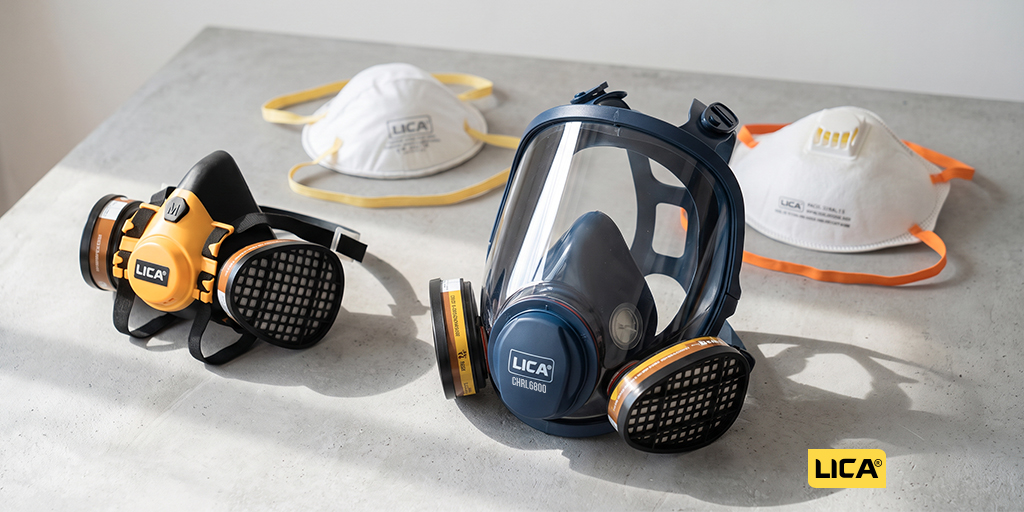
Industrial worker wearing a half-face respirator with respiratory protection on a manufacturing plant floor
Post English, Sin categoría, Tips

Correct Respiratory Protection: How to Choose It by Contaminant

The air in a workplace can contain hazards that are not always visible. Fine dust, organic vapors, acid gases, or paint mist can be present without the worker noticing right away, yet still cause cumulative respiratory damage with every shift. Choosing correct respiratory protection based on the contaminant present is not a minor detail — it is the difference between healthy lungs after years of work and an occupational illness that shows up when it is already too late. Unlike a mechanical injury, respiratory damage tends to be silent and progressive. For that reason, equipment selection cannot be based on assumptions. It must start with a real analysis of the contaminant present at each job position. What Mexican Regulations Require In Mexico, NOM-116-STPS-2009 establishes the characteristics, minimum requirements, and test methods that negative-pressure air-purifying respirators against harmful particles must meet when manufactured, sold, or imported into the country. This standard applies specifically to masks and respirators designed to filter dust, metal fumes, and mists present in the work environment. As a general framework, NOM-017-STPS-2024, in force since September 2025, requires employers to identify the risks of each position, select the corresponding PPE with verifiable certification, train personnel on correct use, and maintain documented records of delivery and replacement. For respiratory protection, this means it is not enough to simply “hand out masks” — employers must provide the correct mask or respirator for the specific contaminant each worker is exposed to. Respiratory Protection by Contaminant Type Low-toxicity solid particlesPresent in activities such as sanding, wood cutting, cement handling, or industrial sweeping. For this risk, disposable filtering masks are the appropriate option. LICA’s CHML10 model is an N95 mask for solid particles, with three-layer construction and staple-free elastic straps, designed to filter fine non-oily particles with certified efficiency. For shifts requiring greater breathing comfort, the CHML11 model incorporates an exhalation valve, with FFP2 NR classification, making it easier to release warm air and humidity without compromising intake filtration. Industrial dust in intermittent tasksFor activities where dust exposure is not continuous throughout the shift — cleaning, maintenance, occasional cutting work — LICA’s CHML09 model, a foldable particulate mask made from white polyester with elastic fit and EN149 certification, offers a practical and portable alternative. Its foldable design makes it easy to carry and store between uses, making it ideal as a backup available at the workstation. Organic vapors and acid gasesPresent in industrial painting, solvent use, chemical cleaning processes, and certain welding operations. Unlike particles, vapors and gases are not filtered mechanically — they require a chemical adsorption medium. For this risk, LICA offers the CHRL200 half-face respirator, made of elastomer with an ergonomic design, compatible with the CHF03 cartridge, classified A1E1, specific for organic vapor and acid gases. This combination is suitable for workers exposed to solvents, inks, industrial adhesives, or certain chemical processes. High-risk combined exposureWhen the work environment presents multiple simultaneous contaminants — particles, vapors, and possible contact with contaminated surfaces — or when complete facial protection is required in addition to respiratory protection, the full-face mask is the appropriate solution. LICA’s CHRL6800 model, made of silicone with an airtight facial seal, protects both the respiratory tract and the eyes simultaneously, and is compatible with specific cartridges depending on the contaminant present. It is the recommended option for processes with higher contaminant concentration or where the risk also involves eye irritation. Factors That Determine Selection Beyond the Contaminant Contaminant concentration. Occasional low-concentration exposure is not the same as a saturated environment. Higher concentration requires a higher protection factor, which may mean moving from a filtering mask to a respirator with cartridge, or even to supplied-air equipment in extreme cases. Exposure time. Prolonged shifts of continuous exposure require equipment with greater filtration capacity and, frequently, greater comfort for sustained use. A disposable mask intended for occasional use is not suitable for eight hours a day of constant exposure. Compatibility with other PPE. In positions that also require safety glasses or hard hats, it is important to verify that the selected respirator does not compromise the facial seal or interfere with other equipment. The full-face mask resolves this point by integrating eye and respiratory protection into a single piece. Facial fit. A respirator that does not seal correctly against the face loses much of its effectiveness, no matter how good the filter’s certification is. The standard requires that fit be verified individually, since face shape varies among workers. What Many Companies Overlook A common mistake is assuming that any mask protects against any contaminant. An N95 mask, certified for solid particles, offers no protection against organic vapors or gases. Likewise, an organic vapor cartridge does not filter coarse solid particles without the corresponding prefilter. The compatibility between the type of threat and the filtration mechanism is non-negotiable. At LICA, we offer a complete line of respiratory protection — from N95 and FFP2 disposable masks to half-face respirators and full-face masks with specific cartridges — designed to cover the main respiratory risks of Mexican industry. All available for companies and distributors throughout the country. Choosing correctly is not just a regulatory obligation. It is protecting something that, once damaged, cannot always be recovered. Need guidance on selecting the correct respiratory protection based on your plant’s contaminants? Contact us or browse our complete respiratory protection line. Sources: Ministry of Labor and Social Welfare (STPS) — NOM-116-STPS-2009, Air-purifying respirators against harmful particles STPS — NOM-017-STPS-2024, Personal Protective Equipment NYCE — Respirator certification under NOM-116-STPS-2009 IMSS — Occupational disease statistics, respiratory exposure, 2023
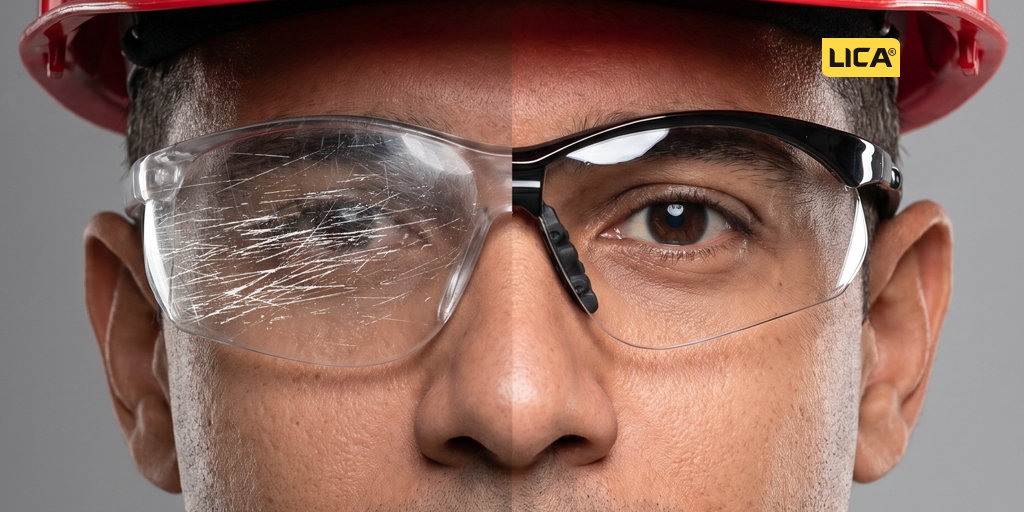
Two pairs of industrial safety glasses side by side — one in perfect condition and one with a scratched lens and deformed frame — on an industrial surface
Post English, Sin categoría, Tips

When to Replace Your Safety Glasses? Signs You Should Not Ignore

There is a silent but widespread criterion for replacing safety glasses in companies: wait until they break. As long as the worker can put them on and see through them, the glasses still “work.” The problem is that safety glasses can stop protecting long before they show obvious damage — and continuing to use them in that condition is not cost savings. It is unmanaged risk. Unlike other PPE whose deterioration is more obvious — a boot with a detached outsole, a torn glove — safety glasses tend to degrade gradually and quietly. Scratches accumulate, the lens loses light transmission, the frame loses its fit. None of those changes stop the worker from putting them on. All of them, however, reduce their actual protective capacity. Do Safety Glasses Have a Defined Service Life? There is no universal expiration date for safety glasses. Their service life depends on the lens material, intensity of use, environmental conditions, and the care they receive. A pair used in metalworking with constant exposure to particles and heat does not last as long as one used in technical office supervision. As a general reference, manufacturers and international safety organizations recommend inspecting safety glasses every six months under intensive use and replacing them at any sign of deterioration, regardless of how much time has passed. What the standard does establish is the obligation to manage this formally. NOM-017-STPS-2024, in force since September 2025, requires employers to have documented procedures for PPE inspection, maintenance, replacement, and final disposal, including delivery records with the worker’s signature. Replacing glasses only when they break does not meet this requirement. Signs That Indicate It Is Time to Replace Safety Glasses Scratches on the lens. This is the most common sign and, at the same time, the most underestimated. Surface scratches reduce visual clarity, create annoying glare from direct light sources, and in high-luminosity environments or nighttime work, compromise the worker’s perception. When scratches cover the central vision zone or make it difficult to read instruments, the glasses must be replaced. An anti-scratch coating extends service life, but does not make it indefinite. Opaque, yellowed, or low-transmission lens. Prolonged exposure to ultraviolet light, heat, or certain chemicals can degrade polycarbonate and cause a gradual opacity that reduces the amount of light reaching the eye. This deterioration directly affects visibility in low-light environments and represents a concrete risk in operations involving machinery or moving vehicles. Persistent fogging that does not respond to treatment. Glasses with factory anti-fog treatment can lose that property over time, especially if cleaned with abrasive materials or exposed to solvents. When fogging becomes frequent and immediate upon putting the glasses on, their functionality in humid or temperature-variable environments is compromised. Deformed frame or loss of fit. A frame that no longer fits correctly to the face creates lateral gaps where particles, splashes, or radiation can enter. ANSI Z87.1 requires effective lateral protection; a deformed frame that leaves the sides exposed fails this requirement even if the lens is intact. Furthermore, glasses that do not stay in the correct position cause visual fatigue and increase the likelihood that the worker will remove them during the shift. Broken, loose, or low-grip temples. The temples are the element that keeps the glasses in place during movement and physical effort. A broken or very loose temple turns the glasses into an accessory that falls off, shifts, or simply does not get used. In operations involving machinery, tools, or work at height, glasses that slip out of the visual field at the wrong moment can lead to an accident. Cracked or inflexible nose bridge. The nose bridge determines how the weight of the glasses is distributed and their position on the face. When it cracks or loses flexibility, the fit becomes uncomfortable, the glasses shift downward, and lateral protection loses effectiveness. Models such as the LICA-TRAN-I include an adjustable nose bridge precisely to adapt to different facial profiles and extend wearing comfort. However, when this component fails, the glasses must be replaced. After a significant impact. If the glasses received a direct impact from a particle, tool, or projectile — even without a visible fracture — they must be removed from service and evaluated before being used again. Polycarbonate can develop internal microfractures that are not detectable to the naked eye but reduce its absorption capacity against a second impact. Glasses that have already fulfilled their protective function in one incident do not guarantee the same level of protection in the next. Damage to special coatings. Glasses with UV filters, REVO coatings, or anti-fog treatments depend on the integrity of those layers to function correctly. When coatings show bubbles, peeling, or permanent stains, the glasses lose the additional properties for which they were purchased. A RUNNER-SM-AZ model with a damaged REVO coating, for example, no longer provides the certified UV400 protection it was designed for. How to Extend Service Life Without Compromising Protection Correct storage and cleaning make a significant difference in the durability of safety glasses. Storing them in their case or soft pouch prevents scratches during transport. Cleaning them with a soft cloth and clean water — never with clothing, paper, or solvents — preserves the coatings. Keeping them away from direct heat sources prevents frame deformation and polycarbonate degradation. Proper care extends service life, however, it does not make it indefinite. When any of the signs described above are present, replacement is the only correct decision. What This Means for Companies and Distributors For companies, having a periodic glasses inspection program is not just good practice — it is a legal obligation under NOM-017-STPS-2024 and the evidence that protects the organization during inspections or in the event of an accident. This program must include inspection frequency, removal criteria, the person responsible for carrying out inspections, and documentary records of each replacement. For distributors, understanding these replacement cycles is a direct business opportunity. A client who understands the real service life of their glasses is a client who purchases regularly, trusts their

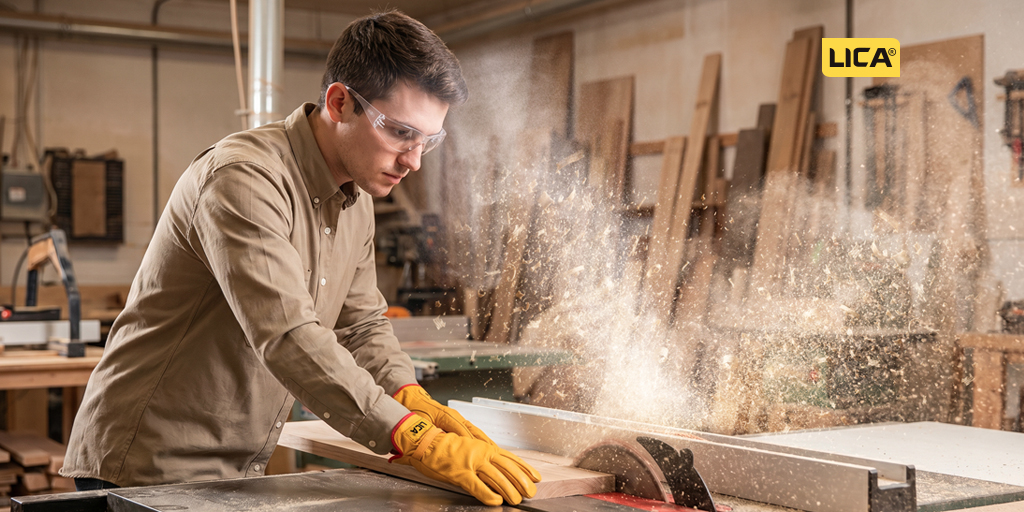
Trabajador industrial usando lentes de seguridad certificados con protección lateral en planta de manufactura
Post English, Sin categoría, Tips

Certified Safety Glasses: What Every Company Needs to Know

The eyes are among the most vulnerable organs in the workplace and, paradoxically, among those that receive the least attention when selecting PPE. In Mexico, eye injuries represent a significant proportion of occupational accidents reported annually to the IMSS. Most of them are preventable with the correct use of certified safety glasses. The problem is not always the absence of eye protection. Frequently, the issue is that the glasses available at the workstation are not certified, are not appropriate for the specific risk, or simply no one verified they met any real technical standard before purchasing them. What Makes Safety Glasses Certified? A certified pair of safety glasses is one that has undergone technical laboratory testing and has demonstrated compliance with minimum parameters of resistance, visual field, and protection. It is not enough for the product to appear resistant or for the manufacturer to describe it as industrial. Certification is the objective evidence that the equipment actually protects. In Mexico, the reference standard for PPE selection and use is NOM-017-STPS-2024, in force since September 2025. This standard establishes that employers must provide PPE certified by an accredited body in accordance with the Federal Law on Metrology and Standardization. For eye protection, when no specific product NOM is currently in force, the standard accepts compliance with recognized international standards. The de facto technical reference for safety glasses in the Mexican and Latin American industry is ANSI Z87.1, issued by the American National Standards Institute. This standard classifies glasses according to their level of impact protection — basic or high impact — and establishes requirements for penetration resistance, light transmission, visual field, and mandatory markings. Glasses that comply with ANSI Z87.1 must carry the corresponding certification code engraved on both the frame and the lens. Additionally, many models available in the Mexican market carry CE certification under European standard EN 166, which establishes similar requirements and includes specific classifications for resistance to liquids, electric arc, and radiation. Both certifications are recognized and accepted by Mexican labor authorities. The Risks That Safety Glasses Must Cover Choosing the right glasses always starts with an analysis of the job position’s risks. Not all environments present the same hazards to the eyes, and glasses designed for one type of risk may be ineffective against another. Impact from particles or fragments. This is the most frequent risk in manufacturing, metalworking, carpentry, and construction. High-velocity projected particles — metal shavings, splinters, coarse dust — can cause serious injuries or vision loss. For this risk, polycarbonate lenses with ANSI Z87.1 certification are required. LICA’s LLI07 model — available in clear (LLI07C-PRO) and dark (LLI07O-PRO) versions — is a PRO polycarbonate lens with wrap-around design and lateral protection, certified under this standard. For those requiring a wider visual field, the LLI06C capataz-style model offers a panoramic polycarbonate lens without a frame, also certified ANSI Z87.1, ideal for plant supervision and work with tools that carry a high projection risk. General use in plant and industry. For positions with exposure to particles, dust, and moderate impact risk, the LICA-TRAN-I model offers a transparent lens with UV protection, black frame, and adjustable nose bridge, certified ANSI Z87.1. For those who need more frame structure, the LLI05 is available in clear and dark lenses, with a two-tone design that combines resistance and comfort during long shifts. For those who prefer a compact low-profile model, the LLI04C sergeant-style in clear lens is a practical option for everyday plant use. UV radiation and outdoor work. For personnel exposed to intense sunlight or prolonged outdoor work, dark lenses and mirrored coatings are the right choice. The LICA-NEG-I model offers a gray high-density polycarbonate lens with ANSI Z87.1 certification, designed for high-luminosity environments. For those who require UV400 protection with REVO mirrored coating, the RUNNER-SM-AZ model from the Safety Man line features a blue REVO lens with black frame and full ultraviolet radiation protection. In the women’s line, the VALQUIRIA-SG-R from Safety Girl offers a brown-pink REVO lens with UV400 protection, combining functionality and design for female workers in outdoor environments. For low-visibility environments or nighttime work, the TACTIC-SM-N with dark lens and included elastic band ensures a secure fit and UV385 protection. Welding radiation. This risk requires specialized protection beyond conventional glasses. Welding hoods and goggles use shade filters calibrated to the process and amperage. However, even under the hood, welders must wear base safety glasses as protection against sparks and slag during auxiliary operations, as established by NOM-027-STPS-2008 on welding and cutting activities. Technical Characteristics That Should Not Be Overlooked Beyond certification and risk type, certain technical attributes determine whether a pair of glasses is actually worn or ends up in the worker’s pocket. Anti-fog treatment. In environments with temperature changes or high humidity, fogging is one of the main reasons workers remove their glasses. A model without this treatment becomes an obstacle rather than protection. Several models in the LICA line incorporate this treatment from the factory to ensure continuous visibility throughout the shift. Anti-scratch coating. Polycarbonate lenses are lightweight and impact-resistant, but susceptible to surface scratches that reduce visual clarity. Over time, these scratches compromise the integrity of the visual field and justify replacing the equipment. An anti-scratch coating significantly extends the service life of the lens. Lateral protection. ANSI Z87.1 requires safety glasses to provide lateral protection, either through a wrap-around frame or additional side shields. Conventional sunglasses, even with dark lenses and UV filters, do not meet this requirement because the sides remain exposed to projections. Fit and comfort. Uncomfortable glasses are glasses that do not get worn. Adjustable temples, a flexible nose bridge, and frame weight are all factors that determine whether the worker consistently uses the equipment. NOM-017-STPS-2024 reinforces this point by establishing that PPE must fit correctly to the user’s physical characteristics. What the Standard Requires in Practice For employers, NOM-017-STPS-2024 establishes concrete obligations regarding eye protection: identifying visual risks for each position, selecting the appropriate certified glasses, documenting delivery with the worker’s signature, providing training on

Whatsapp
Scroll to Top