

The eyes are among the most vulnerable organs in the workplace and, paradoxically, among those that receive the least attention when selecting PPE. In Mexico, eye injuries represent a significant proportion of occupational accidents reported annually to the IMSS. Most of them are preventable with the correct use of certified safety glasses.
The problem is not always the absence of eye protection. Frequently, the issue is that the glasses available at the workstation are not certified, are not appropriate for the specific risk, or simply no one verified they met any real technical standard before purchasing them.
What Makes Safety Glasses Certified?
A certified pair of safety glasses is one that has undergone technical laboratory testing and has demonstrated compliance with minimum parameters of resistance, visual field, and protection. It is not enough for the product to appear resistant or for the manufacturer to describe it as industrial. Certification is the objective evidence that the equipment actually protects.
In Mexico, the reference standard for PPE selection and use is NOM-017-STPS-2024, in force since September 2025. This standard establishes that employers must provide PPE certified by an accredited body in accordance with the Federal Law on Metrology and Standardization. For eye protection, when no specific product NOM is currently in force, the standard accepts compliance with recognized international standards.
The de facto technical reference for safety glasses in the Mexican and Latin American industry is ANSI Z87.1, issued by the American National Standards Institute. This standard classifies glasses according to their level of impact protection — basic or high impact — and establishes requirements for penetration resistance, light transmission, visual field, and mandatory markings. Glasses that comply with ANSI Z87.1 must carry the corresponding certification code engraved on both the frame and the lens.
Additionally, many models available in the Mexican market carry CE certification under European standard EN 166, which establishes similar requirements and includes specific classifications for resistance to liquids, electric arc, and radiation. Both certifications are recognized and accepted by Mexican labor authorities.
The Risks That Safety Glasses Must Cover
Choosing the right glasses always starts with an analysis of the job position’s risks. Not all environments present the same hazards to the eyes, and glasses designed for one type of risk may be ineffective against another.
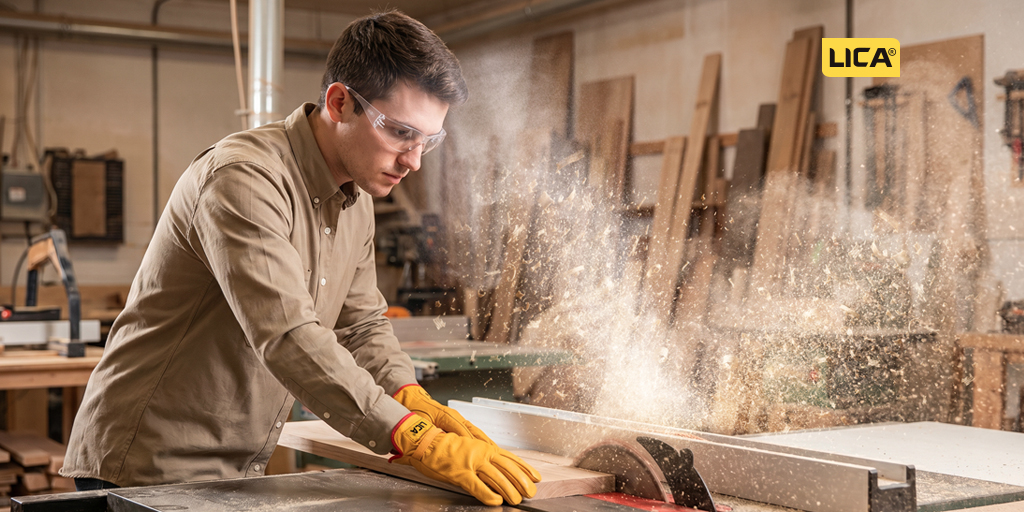
Impact from particles or fragments. This is the most frequent risk in manufacturing, metalworking, carpentry, and construction. High-velocity projected particles — metal shavings, splinters, coarse dust — can cause serious injuries or vision loss. For this risk, polycarbonate lenses with ANSI Z87.1 certification are required. LICA’s LLI07 model — available in clear (LLI07C-PRO) and dark (LLI07O-PRO) versions — is a PRO polycarbonate lens with wrap-around design and lateral protection, certified under this standard. For those requiring a wider visual field, the LLI06C capataz-style model offers a panoramic polycarbonate lens without a frame, also certified ANSI Z87.1, ideal for plant supervision and work with tools that carry a high projection risk.
General use in plant and industry. For positions with exposure to particles, dust, and moderate impact risk, the LICA-TRAN-I model offers a transparent lens with UV protection, black frame, and adjustable nose bridge, certified ANSI Z87.1. For those who need more frame structure, the LLI05 is available in clear and dark lenses, with a two-tone design that combines resistance and comfort during long shifts. For those who prefer a compact low-profile model, the LLI04C sergeant-style in clear lens is a practical option for everyday plant use.
UV radiation and outdoor work. For personnel exposed to intense sunlight or prolonged outdoor work, dark lenses and mirrored coatings are the right choice. The LICA-NEG-I model offers a gray high-density polycarbonate lens with ANSI Z87.1 certification, designed for high-luminosity environments. For those who require UV400 protection with REVO mirrored coating, the RUNNER-SM-AZ model from the Safety Man line features a blue REVO lens with black frame and full ultraviolet radiation protection. In the women’s line, the VALQUIRIA-SG-R from Safety Girl offers a brown-pink REVO lens with UV400 protection, combining functionality and design for female workers in outdoor environments. For low-visibility environments or nighttime work, the TACTIC-SM-N with dark lens and included elastic band ensures a secure fit and UV385 protection.
Welding radiation. This risk requires specialized protection beyond conventional glasses. Welding hoods and goggles use shade filters calibrated to the process and amperage. However, even under the hood, welders must wear base safety glasses as protection against sparks and slag during auxiliary operations, as established by NOM-027-STPS-2008 on welding and cutting activities.
Technical Characteristics That Should Not Be Overlooked
Beyond certification and risk type, certain technical attributes determine whether a pair of glasses is actually worn or ends up in the worker’s pocket.
Anti-fog treatment. In environments with temperature changes or high humidity, fogging is one of the main reasons workers remove their glasses. A model without this treatment becomes an obstacle rather than protection. Several models in the LICA line incorporate this treatment from the factory to ensure continuous visibility throughout the shift.
Anti-scratch coating. Polycarbonate lenses are lightweight and impact-resistant, but susceptible to surface scratches that reduce visual clarity. Over time, these scratches compromise the integrity of the visual field and justify replacing the equipment. An anti-scratch coating significantly extends the service life of the lens.
Lateral protection. ANSI Z87.1 requires safety glasses to provide lateral protection, either through a wrap-around frame or additional side shields. Conventional sunglasses, even with dark lenses and UV filters, do not meet this requirement because the sides remain exposed to projections.
Fit and comfort. Uncomfortable glasses are glasses that do not get worn. Adjustable temples, a flexible nose bridge, and frame weight are all factors that determine whether the worker consistently uses the equipment. NOM-017-STPS-2024 reinforces this point by establishing that PPE must fit correctly to the user’s physical characteristics.
What the Standard Requires in Practice
For employers, NOM-017-STPS-2024 establishes concrete obligations regarding eye protection: identifying visual risks for each position, selecting the appropriate certified glasses, documenting delivery with the worker’s signature, providing training on correct use, and establishing an inspection and replacement program. Scratched glasses, cracked lenses, or deformed frames must be replaced. Keeping them in use for cost-saving reasons is, legally speaking, equivalent to providing no protection at all.
For distributors, understanding the differences between types of glasses and their certifications is a consultative sales argument that sets apart the provider who simply delivers product from the one who advises their client on what they actually need.
At LICA, we offer a complete line of certified safety glasses — from general-use polycarbonate models to UV-filter and REVO-coated options for outdoor work — all available for companies and distributors throughout Mexico. Because certification is not a minor technical detail: it is the difference between glasses that protect and glasses that only appear to.
Need guidance on selecting the right glasses for each position in your company? Contact us or browse our complete safety glasses line.
Sources:
- Ministry of Labor and Social Welfare (STPS) — NOM-017-STPS-2024, Personal Protective Equipment
- STPS — NOM-027-STPS-2008, Welding and Cutting Activities
- American National Standards Institute — ANSI Z87.1, Occupational and Educational Personal Eye and Face Protection Devices
- IMSS — Occupational risk statistics, eye injuries, 2023
- European Committee for Standardization — EN 166, Personal eye protection specifications