


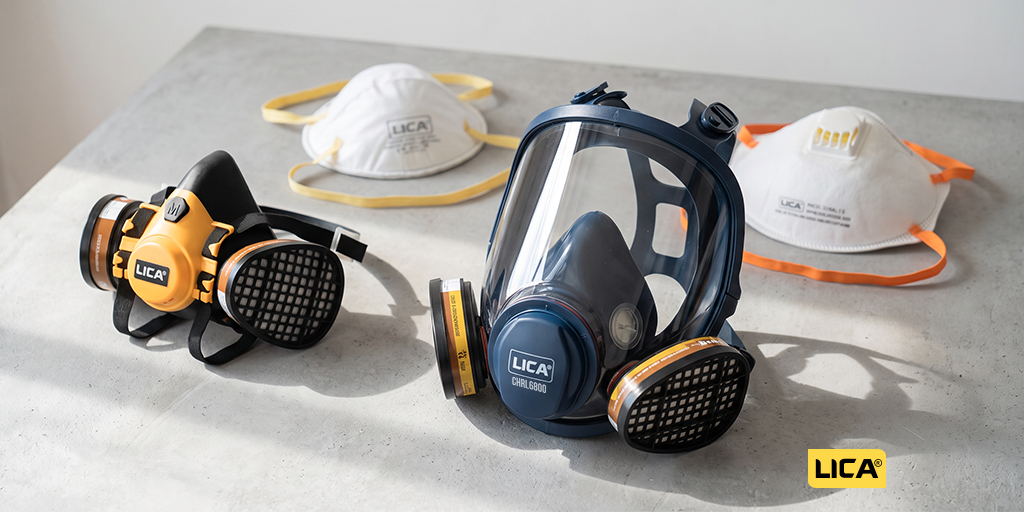
The air in a workplace can contain hazards that are not always visible. Fine dust, organic vapors, acid gases, or paint mist can be present without the worker noticing right away, yet still cause cumulative respiratory damage with every shift. Choosing correct respiratory protection based on the contaminant present is not a minor detail — it is the difference between healthy lungs after years of work and an occupational illness that shows up when it is already too late.
Unlike a mechanical injury, respiratory damage tends to be silent and progressive. For that reason, equipment selection cannot be based on assumptions. It must start with a real analysis of the contaminant present at each job position.
What Mexican Regulations Require
In Mexico, NOM-116-STPS-2009 establishes the characteristics, minimum requirements, and test methods that negative-pressure air-purifying respirators against harmful particles must meet when manufactured, sold, or imported into the country. This standard applies specifically to masks and respirators designed to filter dust, metal fumes, and mists present in the work environment.
As a general framework, NOM-017-STPS-2024, in force since September 2025, requires employers to identify the risks of each position, select the corresponding PPE with verifiable certification, train personnel on correct use, and maintain documented records of delivery and replacement. For respiratory protection, this means it is not enough to simply “hand out masks” — employers must provide the correct mask or respirator for the specific contaminant each worker is exposed to.
Respiratory Protection by Contaminant Type
Low-toxicity solid particles
Present in activities such as sanding, wood cutting, cement handling, or industrial sweeping. For this risk, disposable filtering masks are the appropriate option. LICA’s CHML10 model is an N95 mask for solid particles, with three-layer construction and staple-free elastic straps, designed to filter fine non-oily particles with certified efficiency. For shifts requiring greater breathing comfort, the CHML11 model incorporates an exhalation valve, with FFP2 NR classification, making it easier to release warm air and humidity without compromising intake filtration.
Industrial dust in intermittent tasks
For activities where dust exposure is not continuous throughout the shift — cleaning, maintenance, occasional cutting work — LICA’s CHML09 model, a foldable particulate mask made from white polyester with elastic fit and EN149 certification, offers a practical and portable alternative. Its foldable design makes it easy to carry and store between uses, making it ideal as a backup available at the workstation.
Organic vapors and acid gases
Present in industrial painting, solvent use, chemical cleaning processes, and certain welding operations. Unlike particles, vapors and gases are not filtered mechanically — they require a chemical adsorption medium. For this risk, LICA offers the CHRL200 half-face respirator, made of elastomer with an ergonomic design, compatible with the CHF03 cartridge, classified A1E1, specific for organic vapor and acid gases. This combination is suitable for workers exposed to solvents, inks, industrial adhesives, or certain chemical processes.
High-risk combined exposure
When the work environment presents multiple simultaneous contaminants — particles, vapors, and possible contact with contaminated surfaces — or when complete facial protection is required in addition to respiratory protection, the full-face mask is the appropriate solution. LICA’s CHRL6800 model, made of silicone with an airtight facial seal, protects both the respiratory tract and the eyes simultaneously, and is compatible with specific cartridges depending on the contaminant present. It is the recommended option for processes with higher contaminant concentration or where the risk also involves eye irritation.
Factors That Determine Selection Beyond the Contaminant
Contaminant concentration. Occasional low-concentration exposure is not the same as a saturated environment. Higher concentration requires a higher protection factor, which may mean moving from a filtering mask to a respirator with cartridge, or even to supplied-air equipment in extreme cases.
Exposure time. Prolonged shifts of continuous exposure require equipment with greater filtration capacity and, frequently, greater comfort for sustained use. A disposable mask intended for occasional use is not suitable for eight hours a day of constant exposure.
Compatibility with other PPE. In positions that also require safety glasses or hard hats, it is important to verify that the selected respirator does not compromise the facial seal or interfere with other equipment. The full-face mask resolves this point by integrating eye and respiratory protection into a single piece.
Facial fit. A respirator that does not seal correctly against the face loses much of its effectiveness, no matter how good the filter’s certification is. The standard requires that fit be verified individually, since face shape varies among workers.
What Many Companies Overlook
A common mistake is assuming that any mask protects against any contaminant. An N95 mask, certified for solid particles, offers no protection against organic vapors or gases. Likewise, an organic vapor cartridge does not filter coarse solid particles without the corresponding prefilter. The compatibility between the type of threat and the filtration mechanism is non-negotiable.
At LICA, we offer a complete line of respiratory protection — from N95 and FFP2 disposable masks to half-face respirators and full-face masks with specific cartridges — designed to cover the main respiratory risks of Mexican industry. All available for companies and distributors throughout the country.
Choosing correctly is not just a regulatory obligation. It is protecting something that, once damaged, cannot always be recovered.
Need guidance on selecting the correct respiratory protection based on your plant’s contaminants? Contact us or browse our complete respiratory protection line.
Sources:
- Ministry of Labor and Social Welfare (STPS) — NOM-116-STPS-2009, Air-purifying respirators against harmful particles
- STPS — NOM-017-STPS-2024, Personal Protective Equipment
- NYCE — Respirator certification under NOM-116-STPS-2009
- IMSS — Occupational disease statistics, respiratory exposure, 2023