

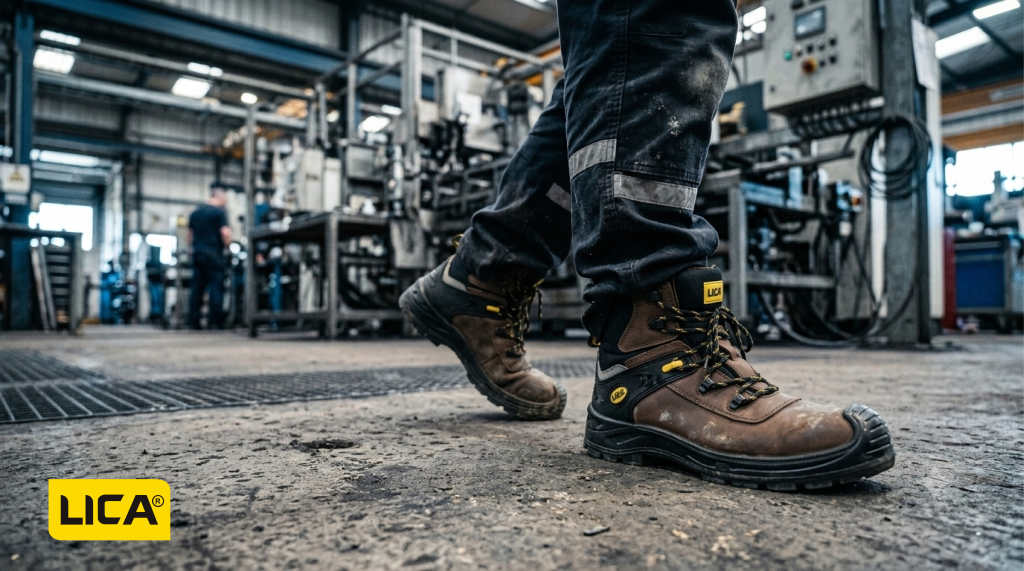
Safety footwear is the PPE that accumulates the most contact hours with the worker. An eight-hour shift means eight hours of continuous exposure to floor-level hazards: sharp objects, slippery surfaces, falling loads, electrical current, moisture, and chemicals. Yet in many companies, it remains the equipment chosen with the least technical criteria.
Choosing safety footwear by industry and risk type is not bureaucracy. It is the difference between a worker who is protected and one who believes they are.
What the Standard Establishes
In Mexico, NOM-113-STPS-2009 specifically regulates safety footwear conditions. It establishes the minimum requirements for impact resistance, compression resistance, penetration resistance, and slip resistance that any footwear used as PPE must meet. This standard is complemented by NOM-017-STPS-2024, in force since September 2025, which requires employers to select PPE based on a risk analysis per job position and maintain documented records of delivery and replacement.
Footwear without certification under these standards is not PPE. It is just footwear.
Safety Footwear by Industry: What to Use and When
Food and Agro-Industry
In environments where floors are constantly wet with grease, blood, oils, or organic residue, the main risk is slipping and falling. The right footwear for this sector is the PVC boot, manufactured in a single piece that eliminates seams where bacteria accumulate and allows thorough cleaning. LICA offers the B-PVC-BR model (white, for food industry environments where this color is required) and B-PVC-NEG (black, for agro-industry and field work), both with certified non-slip outsoles. For environments that also require solvent resistance, the B-PVC-NR model incorporates this additional protection.
Construction and Civil Works
Risks in this sector are multiple and simultaneous: falling objects, nails on the ground, uneven surfaces, moisture, and mud. Footwear must include a steel or polyamide toe cap for impact resistance, an anti-penetration insole for protection against sharp objects, and a high-grip outsole for irregular surfaces. LICA work boots, manufactured with direct injection-to-upper technology using Italian machinery, provide a seamless bond between upper and outsole that increases durability and waterproofing under field conditions.
Electrical Work, Installation, and Maintenance
For workers exposed to electric shock risk, dielectric footwear is a non-negotiable requirement. This type of footwear uses non-conductive outsoles and materials that interrupt the flow of electrical current. LICA offers a complete line of dielectric footwear including the 105PLUS (dielectric boot with polyamide toe cap), the 107PLUS-SP (with thermoplastic eyelets and reflective strip), the 109PLUS-SP (with dual NOM-ASTM certification), and the 229N-SP (dielectric anti-penetration boot in microfiber). All are designed to meet the specific requirements of the electrical sector.
Manufacturing and Metalworking
In plant environments, the most frequent risks are impact from heavy objects, abrasion from metal surfaces, and spills of lubricants or oils. The steel or polyamide toe cap work boot with a hydrocarbon-resistant outsole is the standard in this sector. Safety sneakers are a valid alternative for positions where mobility and comfort are priorities, provided they include the required metatarsal and toe protection.
Logistics and Warehousing
Constant movement, concrete floors, and the risk of crushing from forklifts or pallets define this sector. Footwear must prioritize comfort over long shifts, toe impact protection, and a non-slip outsole. Lightweight safety sneakers are often the best option for this profile, always certified under NOM-113-STPS.
Field Work, Supervision, and Outdoor Activities
For personnel who combine walking on uneven terrain with site supervision or outdoor activities, LICA’s hiking line offers occupational boots with TR synthetic non-slip outsoles designed for mixed terrain. The Trepator 793SM-O model and its variants are built for this use profile.
Beyond the Sector: Factors That Always Need to Be Reviewed
Regardless of industry, three factors determine whether safety footwear truly does its job.
Sizing and fit are critical. Tight footwear causes fatigue and pressure injuries; loose footwear reduces stability and increases the risk of tripping. The standard is clear: PPE must be the right size for each worker.
Valid certification is the only real guarantee that the footwear was subjected to technical testing. Verifying that the model carries NOM-113-STPS certification is the first step before any purchase.
Service life is not unlimited. A worn outsole loses traction; a dented toe cap loses its certified impact absorption capacity. NOM-017-STPS-2024 requires documenting PPE replacement. Establishing a periodic footwear inspection program is both a regulatory obligation and a concrete preventive measure.
At LICA, we manufacture safety footwear with over 40 years of experience in the Mexican industrial market. Our European direct injection-to-upper technology guarantees a structural bond between upper and outsole that translates into greater durability and real protection under intensive use conditions. Our full catalog is available for companies and distributors throughout Mexico.
Need guidance on choosing the right footwear for each position in your company? Contact us or browse our complete safety footwear catalog.
Sources:
- Ministry of Labor and Social Welfare (STPS) — NOM-113-STPS-2009, Protective Footwear
- STPS — NOM-017-STPS-2024, Personal Protective Equipment
- IMSS — Occupational risk statistics, 2023