
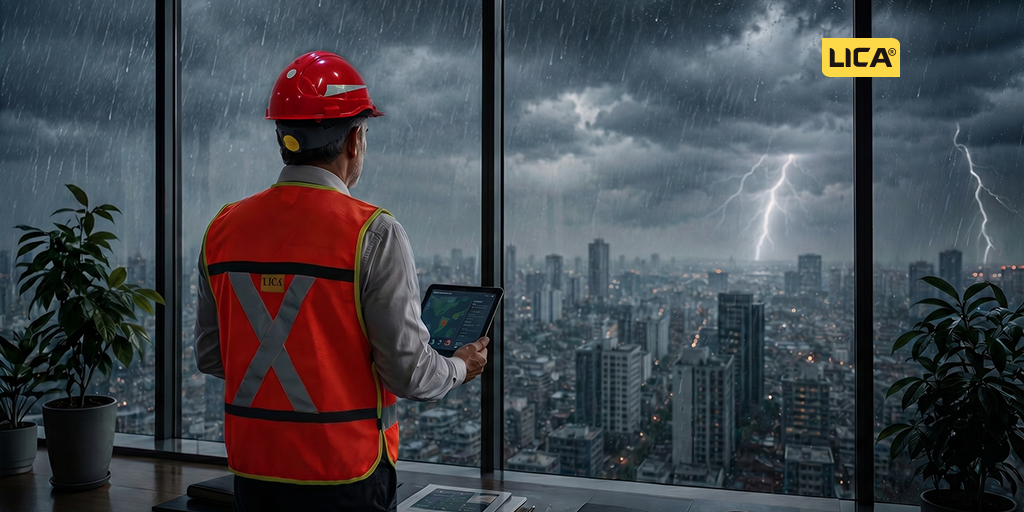
The rainy season does not give exact notice. It arrives, and when it does, companies that were not prepared face the consequences in productivity, safety, and regulatory compliance all at once.
According to the National Meteorological Service, Mexico’s rainy season formally begins in May and extends through November. For the western and Pacific regions — where a large share of the country’s industrial activity is concentrated, including Jalisco — rainfall begins in late May, with peak intensity in July, August, and September. That is six months of continuous exposure for any company with personnel working outdoors, on job sites, in logistics, or in the field.
Last season’s numbers illustrate the scale of the risk clearly. In October 2025, torrential rains triggered floods and landslides that caused the deaths of at least 72 people, left more than 320,000 without electricity, and damaged nearly 1,000 kilometers of roads across six states. Beyond the human toll, the impact on industrial operations, transportation routes, and infrastructure was significant. And in many cases, preventable.
Preparing before the water arrives is not a bureaucratic exercise. It is a management decision that directly affects operational continuity, personnel safety, and compliance with NOM-017-STPS-2024.
What Should a Company Review Before the Season Begins?
1. Audit existing rain PPE
The first step is knowing what is actually on hand. Many companies have rainwear sitting in storage that has gone months or even years without inspection. Rainwear stored under inadequate conditions — humidity, direct sunlight, permanent folding — can develop cracks in the material, open seams, or loss of waterproofing that is not immediately visible.
The review should cover: material integrity (no tears, cracks, or perforations), condition of closures and buttons, functionality of reflective tape, and proper fit by worker size. Any equipment that does not pass this review should be replaced before the season begins, not during it.
2. Map exposed positions and risk type
Not every position requires the same level of rain protection. A field supervisor constantly moving across a job site has different needs than a forklift operator who occasionally goes out to the yard, or a security guard making nighttime rounds in areas with vehicle traffic.
NOM-017-STPS-2024 requires that PPE selection be based on a specific risk analysis for each position. For rainwear, that means determining whether the worker needs a full jacket-and-pants set for prolonged exposure — such as LICA’s JSPIL or JSPHV-L models — a GIL raincoat for moderate supervision and movement, or a portable PIL LIGERO poncho as backup for occasional exposure. Each profile has its solution. Equipping everyone with the same model is as inefficient as equipping no one at all.
3. Verify coverage by number of workers
A common mistake is counting available PPE without accounting for shift rotation, workforce growth, or accumulated losses from wear and misplacement. Real coverage must ensure that every exposed worker has their own individual equipment — the standard prohibits shared PPE use — and that a minimum replacement inventory exists to handle failures during the season without interrupting operations.
4. Update delivery and replacement records
NOM-017-STPS-2024 requires documentation of every PPE delivery: what equipment was issued, to whom, on what date, and with the worker’s signature. This record is not only a legal requirement during a STPS inspection — it is also the evidence that protects the company in the event of an accident. Starting the season with updated records is just as important as having the physical equipment available.
5. Train personnel on proper use and care
It sounds basic, but lack of instruction on correct PPE use is one of the most common causes of premature deterioration. Does the worker know that PVC rainwear should not be folded at sharp angles for storage? That it should not be washed with abrasive detergents? That reflective tape must remain visible and not be covered by other equipment or tools?
The standard establishes the employer’s obligation to train personnel on the correct use, maintenance, and service life of PPE. A brief session before the season begins can significantly extend equipment life and reduce replacement frequency.
6. Establish an inspection protocol for the duration of the season
Preparation does not end on the first day it rains. Throughout the six months of the season, equipment must be reviewed periodically. A rainwear garment that was torn in the field and never reported is a blind spot in the safety program. Defining a review frequency — monthly or after significant rain events — and assigning a responsible party to carry it out turns the initial preparation into a sustained process.
The Right Supplier Is Also Part of the Preparation
A well-prepared company also needs the assurance of being able to replace equipment during the season without depending on long lead times or stock shortages. At LICA, we maintain permanent inventory across our full line of industrial rainwear — ponchos, jacket-and-pants sets, and raincoats in various colors and sizes — available for companies and distributors throughout Mexico. Because preparing for the season includes knowing who to call when a worker’s rainwear fails mid-shift.
The rainy season arrives on schedule every year. The question is not whether it will come — it is whether the company will be ready when it does.
Want to review your current rain PPE inventory or get a quote for the season? Contact us.
Sources:
- National Meteorological Service (SMN) / El Universal — 2025 Rainy Season in Mexico, dates and intensity by region
- UNDP Mexico — Floods in Mexico, October 2025
- ERN Consultores — Flood damage bulletin, October 2025
- Ministry of Labor and Social Welfare (STPS) — NOM-017-STPS-2024, Personal Protective Equipment