

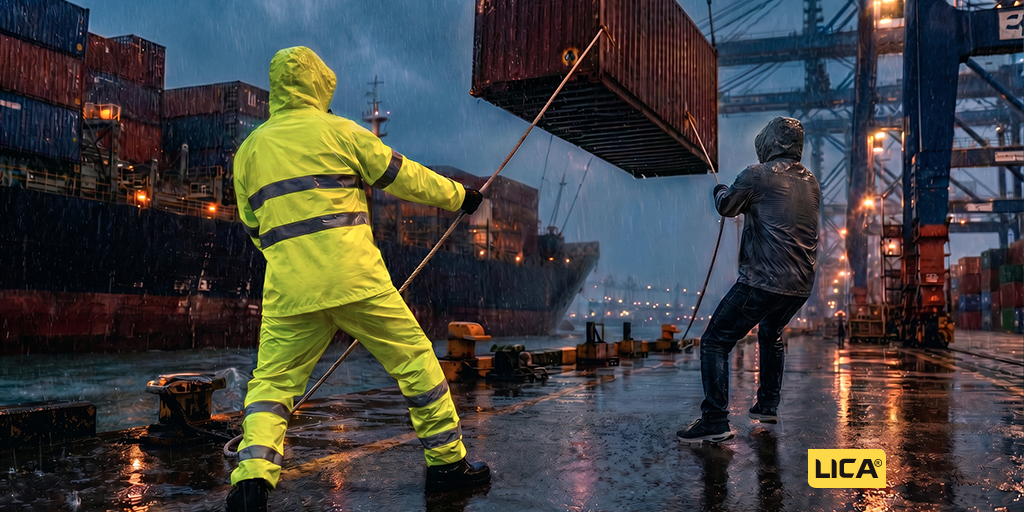
Every rainy season, the same scene plays out in many companies: someone in purchasing finds rainwear at a good price, it gets distributed among the staff, and the matter is considered closed. The problem is that being “covered on paper” does not mean workers are actually protected. Not everything that repels water is industrial rainwear. And that difference, in a work environment, can be costly.
A casual or promotional rainwear item is designed to handle a light drizzle on the way to the car. Industrial rainwear is designed to withstand full shifts in adverse conditions, resist contact with rough surfaces, maintain its waterproofing after hundreds of hours of use, and in many cases, keep the worker visible when natural visibility is insufficient. These are different products for different needs, and treating them as equivalent is a mistake that NOM-017-STPS-2024 does not allow.
The Difference Starts with the Material
General-use rainwear is typically made from low-gauge PVC or fabrics with a surface polyurethane coating. This type of coating repels water under normal conditions, but degrades with use, friction, and sun exposure. Over time — sometimes within just a few weeks of intensive use — the coating loses effectiveness and the fabric begins to leak.
Industrial rainwear uses PVC with integrated textile backing, meaning the material has a woven fabric layer that provides structural strength, prevents easy tearing, and maintains waterproofing even under tension. The 80% PVC / 20% polyester composition that defines LICA’s industrial models — such as the JSPIL, JSPIL BLUE, and JSPHV-L jacket-and-pants sets, or the GIL and GIL-NARANJA raincoats — is not an aesthetic choice. It is a technical specification that determines how long that rainwear will continue protecting the worker who uses it every day.
Seam Sealing: The Detail That Fails Most Often
A rainwear garment can be made from the best material on the market and still leak if its seams are not properly sealed. In casual rainwear, seams are typically closed with thread, which creates small perforations in the material where water penetrates under pressure or during heavy rain.
Industrial rainwear uses high-frequency sealing, a process in which the joints are fused using electromagnetic waves, creating a watertight bond without perforations. The result is a seam that does not leak, does not fray, and does not come apart with use. In LICA’s GIL and GIL-NARANJA models, this sealing is part of the product’s technical specification — precisely because they are designed for real rain exposure, not occasional use.
Buttons and Closures Matter Too
It may seem like a minor detail, but metal closures on work rainwear are a concrete problem. In humid environments, metal corrodes, buttons jam, and zippers fail at the worst possible moment. Industrial rainwear uses durable plastic buttons and closures that do not rust, do not conduct electricity, and maintain their functionality throughout the equipment’s service life. All LICA models — from jacket-and-pants sets to raincoats — are equipped with anticorrosion plastic buttons for this reason.
Visibility: The Element That Separates PPE from a Purchase Decision
Rainwear without reflective tape may be sufficient for indoor work or areas without vehicle traffic. However, for personnel on construction sites, roadways, logistics operations, or any environment with moving machinery or vehicles, the absence of reflective strips turns the rainwear into an additional risk factor. In rain, visibility drops dramatically. A worker dressed in dark colors under those conditions is barely perceptible to a machinery operator or a driver.
LICA’s JSPHV-L model incorporates high-visibility reflective tape precisely for these environments. The GIL and GIL-NARANJA raincoats also include reflective elements in their design. This is not a decorative accessory — it is an active safety element that NOM-017-STPS-2024 requires employers to consider when the job position’s risk demands it.
What the Standard Requires and What Many Companies Overlook
NOM-017-STPS-2024 establishes that PPE must be selected based on the specific risk of each position, must be the appropriate size, must carry certification from an accredited body, and must have a documented program for inspection, maintenance, and replacement. A promotional rainwear item purchased from the cheapest vendor on the market will rarely meet these requirements. In the event of an inspection or an accident, the company is exposed to both financial penalties and legal liability for the consequences.
Equipping personnel with PPE that does not meet the required technical specifications is, legally speaking, equivalent to providing no PPE at all.
The Real Cost of the Wrong Rainwear
The price difference between an industrial rainwear garment and a general-use one may seem significant at the point of purchase. That difference reverses quickly when replacement frequency is factored in. A low-gauge rainwear item used intensively in industrial settings can deteriorate within weeks. One built to the correct specifications can last an entire rainy season and beyond, with proper maintenance. Beyond that, the cost of a workplace accident — disability payments, increased IMSS risk premiums, legal proceedings, lost productivity — far exceeds any savings made at the time of purchase.
At LICA, we offer a line of industrial rainwear designed for the real demands of the Mexican work environment: textile-backed materials, high-frequency sealed seams, anticorrosion plastic buttons, and high-visibility reflective tape where the risk requires it. Because the difference between a rainwear garment and PPE is not on the label — it is in how it was made and what it was designed to do.
Want to verify whether the rainwear your company uses meets NOM-017-STPS-2024 requirements? Contact us and we will be happy to assist you.
Sources:
- Ministry of Labor and Social Welfare (STPS) — NOM-017-STPS-2024, Personal Protective Equipment
- IMAI Impermeables América Industrial — Technical characteristics: industrial vs. general-use rainwear
- Prolaboral — Hydrophobic fabrics vs. waterproof garments: technical differences, 2024
- Juba PPE — The difference between waterproof and water-resistant workwear