
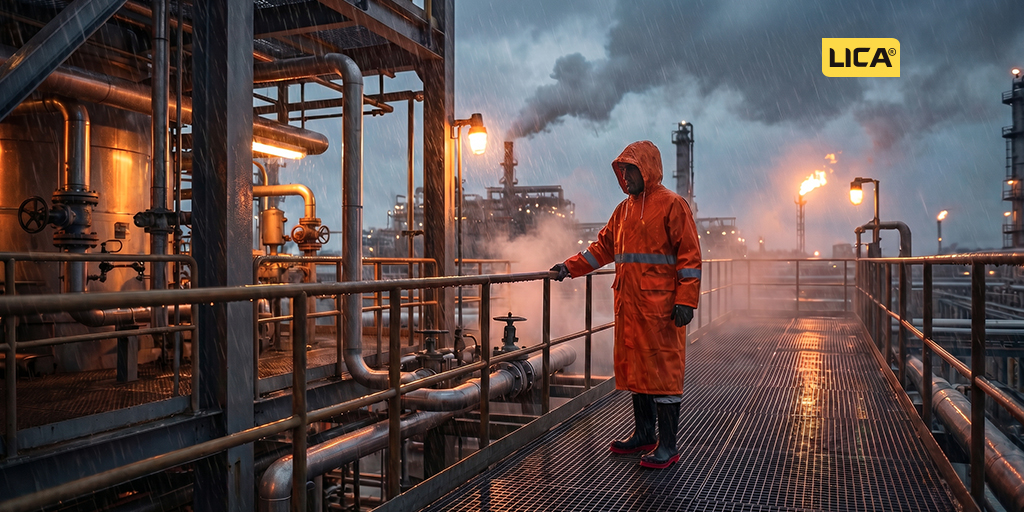
In many sectors of Mexican industry, rain does not stop operations. At most, it stops productivity when the protective equipment is not up to the task. A soaked worker loses performance, faces thermal risks, reduces their visibility, and in certain environments, confronts hazards that go far beyond arriving home wet.
According to the National Meteorological Service, Mexico’s rainy season formally begins in May and extends through November. Jalisco, along with Michoacán, Colima, Guerrero, and other states in the western and Pacific regions, sees rainfall from late May onward, with peak intensity in July, August, and September. For companies with personnel in the field, on construction sites, or in logistics, that represents nearly six months of continuous exposure to wet conditions. Choosing the right rainwear is not a minor decision: it is part of the PPE program.
Rainwear Is Also PPE
A common mistake in companies is treating rainwear as a comfort item rather than protective equipment. NOM-017-STPS-2024 establishes that PPE must be selected based on the specific risks of each job position. When that position involves exposure to rain, humidity, or outdoor work, rainwear becomes part of the risk analysis and must meet the same requirements as any other equipment: correct sizing, certification, documented service life, and recorded replacement.
Choosing the wrong type of rainwear can be just as problematic as having none at all.
The Main Types and When to Use Each
Poncho or Cape This is the lightest and most portable option. Its design covers the torso and arms without requiring separate pants, making it practical for short trips or intermittent rain exposure. At LICA, we offer the PIL and PIL BLACK models — cape-style rainwear with a hood and side snaps, made from 80% PVC and 20% polyester, available in one size. For those who need an even lighter and more transportable option, the PIL LIGERO model is a 100% PVC poncho with an adjustable hood that comes with a portable carry bag, ideal for personnel who need to keep it on hand as a backup.
Suitable for: logistics personnel, site supervisors, machinery operators, and workers who frequently move between covered and open areas.
Jacket and Pants Set This is the most complete protection for prolonged rain exposure. It covers the entire body and allows greater freedom of movement than a poncho. The JSPIL model from LICA is a yellow set featuring a hooded jacket with zipper and plastic buttons, and pants with an elastic waistband and double-reinforced crotch; available in sizes M, L, XL, and XXL. For low-visibility environments — construction sites, roadways, night logistics — the JSPHV-L model incorporates high-visibility reflective tape, a critical safety element that a basic poncho does not offer. Those who need a navy blue option can choose the JSPIL BLUE, which shares the same technical specifications.
Suitable for: workers in construction, civil works, infrastructure maintenance, field operations, and any position with continuous exposure to rain.
Industrial Raincoat This style provides coverage from the shoulders to below the knee in a single garment, combining broad protection with ease of use. The GIL model from LICA is a high-frequency sealed raincoat with anticorrosion plastic buttons and high-visibility reflective tape, made from 80% PVC and 20% polyester. It is also available as the GIL-NARANJA for environments where safety orange is an operational requirement. For situations where the uniform beneath must remain visible without sacrificing protection, the GIL TRANSPARENT-L model — made from 100% translucent PVC with a long sleeve, hood, and side pockets — allows the work clothing underneath to show through without compromising waterproofing.
Suitable for: security personnel, supervisors, workers in vehicle traffic zones, and outdoor plant operators.
What to Review Beyond the Type
The material is the first criterion, but not the only one. Before selecting rainwear to equip personnel, it is worth reviewing the following:
Seams and sealing. Rainwear that leaks through its seams stops doing its job. Industrial-grade models use high-frequency sealing, which bonds the material without needle perforations, eliminating the most common leak points.
Reflective tape. In environments with vehicle traffic, heavy machinery, or reduced visibility, reflective strips are not a decorative feature. They are an active safety element that can prevent a collision or a run-over. NOM-017-STPS-2024 is explicit that PPE must address the actual risks of each position — and if that risk includes low visibility, rainwear must account for it.
Sizing and fit. Rainwear that is too loose can catch on machinery or restrict movement. A too-tight fit limits mobility and causes fatigue. The standard is clear: PPE must be the right size so that it does not create risks of its own.
Compatibility with other PPE. In many positions, rainwear is worn alongside a hard hat, harness, or vest. It is important to verify that the rainwear design does not interfere with these items or compromise their function.
At LICA, we offer a complete line of industrial rainwear designed for the different exposure profiles of Mexican industry — from portable ponchos to high-visibility raincoats. All available for companies and distributors throughout the country, with the assurance that each model was designed for a real risk, not just to hang in a locker.
Need guidance on selecting the right rainwear for your company or expanding your catalog as a distributor? Contact us.
Sources:
- National Meteorological Service (SMN) — 2025 Rainy Season in Mexico
- Milenio / El Universal — Dates and most affected states, 2025 rainy season
- Ministry of Labor and Social Welfare (STPS) — NOM-017-STPS-2024, Personal Protective Equipment