
Every season, many companies make the same mistake: equipping outdoor workers with conventional sunglasses under the argument that they “also protect the eyes.” It is a decision that seems reasonable, proves economical, and in practice leaves the worker unprotected. Sunglasses and industrial safety glasses may look similar, but they are products designed for completely different purposes. Confusing them has legal, technical, and above all, human consequences.
The Starting Point: What Was Each One Designed For?
Sunglasses were designed to reduce brightness and filter UV radiation during everyday outdoor activities. Their objective is visual comfort. They were not conceived to resist the impact of a metal particle projected at high velocity, nor to protect against chemical splashes, nor to maintain structural integrity against a welding spark.
Industrial safety glasses, on the other hand, were designed to protect. Every element of their construction — the lens material, the frame design, the lateral coverage, the coatings — responds to an analysis of specific occupational hazards. Their objective is not comfort: it is the prevention of serious or permanent eye injuries.
Both may have dark lenses. Both may filter UV. That, however, is where the similarities that matter end.
The Difference That Determines Whether a Lens Protects or Not: The Impact Test
A common pair of sunglasses or optical eyewear without certification is not designed to withstand risks such as particle impacts. An uncertified lens can shatter upon impact and become an additional hazard. This point is critical: a lens that fragments upon impact does not just fail to protect the eye — it projects shards directly into it.
The ANSI Z87.1 standard establishes two levels of impact protection for industrial safety glasses. The basic Z87.1 level requires the lens to withstand a 500-gram weight dropped vertically from 1.27 meters. The high-impact level, marked as Z87.1+, is designed to offer greater protection against higher-energy and higher-velocity objects. No standard sunglasses undergo these tests or must meet these thresholds to be sold commercially.
A Z87+ certified lens will carry that marking engraved on both the frame and the lens. If a lens does not have that marking, it has not been tested under that standard. Regardless of how it looks, it is not PPE.
Lateral Protection: The Detail Sunglasses Do Not Address
Conventional sunglasses are designed with a front frame that covers the direct vision area. The sides, top, and bottom remain partially exposed. In a recreational activity, that is acceptable. In an industrial environment, it is an entry point for particles, sparks, splashes, and dust.
ANSI Z87.1 requires industrial safety glasses to provide effective lateral protection, either through a single-piece wrap-around frame or through additional side shields. This requirement does not exist in sunglasses design. Models such as the LLI07C-PRO and LLI07O-PRO from LICA incorporate wrap-around polycarbonate design that covers the lateral exposure angles precisely because of this regulatory requirement.
UV Filter: Present in Both, but Not Equivalent
Both quality sunglasses and industrial safety glasses may include UV filters. However, for a safety lens to pass the UV test under ANSI Z87.1, it must block at least 99.9% of ultraviolet rays under controlled UV lamp exposure. UV protection in commercial sunglasses varies significantly by manufacturer and price point, without an equivalent mandatory standardized verification process.
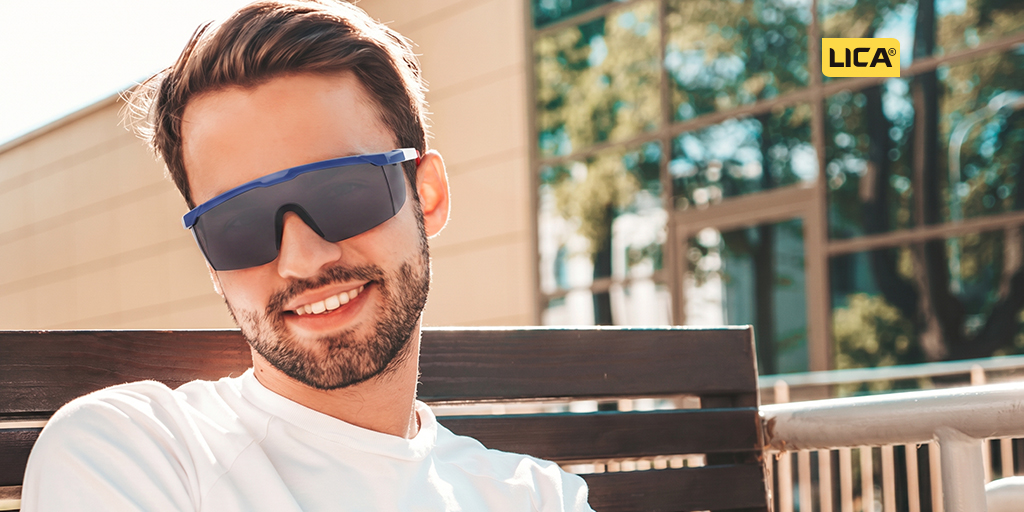
For outdoor work with prolonged sun exposure, the difference is not just whether the lens filters UV, but whether that protection was technically verified. The RUNNER-SM-AZ model with UV400 protection and the LICA-NEG-I with high-density gray polycarbonate lens, both from LICA and certified under ANSI Z87.1, offer that technical assurance that a generic pair of sunglasses cannot provide.
Optical Clarity: A Safety Requirement, Not Just a Comfort Factor
Industrial safety glasses must meet light transmission and optical clarity requirements that ensure the worker perceives their environment accurately. ANSI Z87.1 includes specific optical clarity requirements as an integral part of the certification. Optical distortion in an industrial environment — due to low-quality material or lens deformation — can affect the perception of distances, the reading of instruments, or the detection of warning signals.
Low-price sunglasses frequently present optical distortions that in recreational use are annoying but tolerable. In operations involving machinery or moving vehicles, that distortion can directly contribute to an accident.
What the Standard Requires: It Is Not Optional
NOM-017-STPS-2024 establishes that PPE provided by the employer must carry certification from an accredited body. Providing conventional sunglasses as a substitute for certified industrial safety glasses does not meet this requirement. In the event of a STPS inspection or an occupational eye injury, the company is exposed to sanctions and legal liability, regardless of whether the worker was wearing something over their eyes.
Equipping personnel with PPE that does not meet the required technical specifications is, legally speaking, equivalent to providing no protection at all.
The Real Cost of the Confusion
The price difference between a generic pair of sunglasses and a certified industrial safety lens may seem significant in a bulk purchase. That calculation changes drastically, however, when the cost of an eye injury is factored in: medical care, temporary or permanent disability, increased IMSS risk premiums, and the resulting legal process. According to data from the International Labour Organization, eye injuries represent a significant proportion of preventable occupational accidents globally. Most occur in environments where some form of protection was present — but not the right one.
At LICA, we offer a complete line of industrial safety glasses certified under ANSI Z87.1 — from general plant-use models such as the LLI06C capataz-style and the LICA-TRAN-I with adjustable nose bridge, to dark-lens and REVO-coated options for outdoor work such as the RUNNER-SM-AZ and the Safety Girl line for female workers — all available for companies and distributors throughout Mexico. Because the right eye protection is not the one that appears to protect: it is the one that was tested to do so.
Want to verify whether the glasses your personnel use meet NOM-017-STPS-2024 requirements? Contact us or browse our complete safety glasses line.
Sources:
- Ministry of Labor and Social Welfare (STPS) — NOM-017-STPS-2024, Personal Protective Equipment
- American National Standards Institute — ANSI Z87.1, Occupational and Educational Personal Eye and Face Protection Devices
- Bryan Safety México — ANSI Z87.1 classification by impact level, 2024
- Anbu Safety — ANSI Z87.1 vs EN 166 comparative, 2023
- International Labour Organization (ILO) — Statistics on eye injuries in work environments