


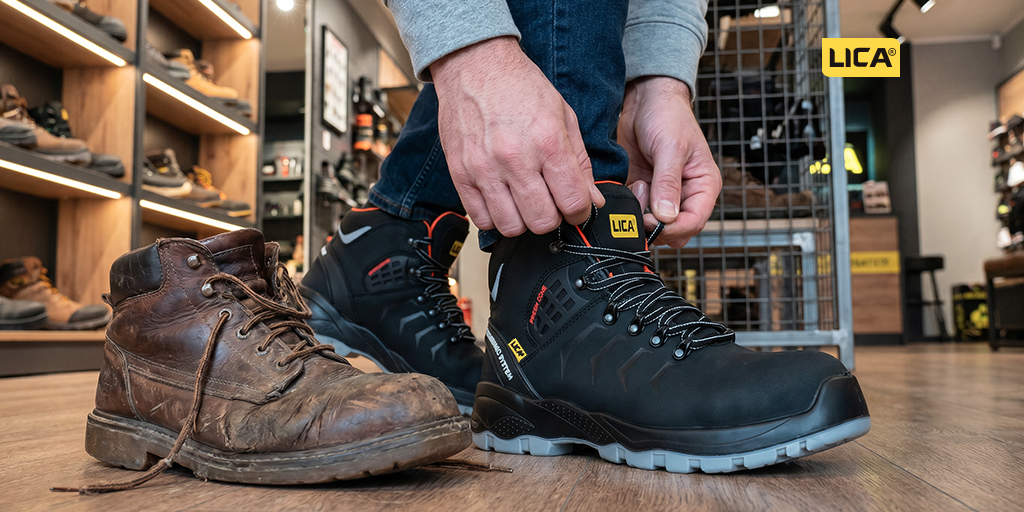
There is a very common criterion for replacing safety footwear in Mexican companies: waiting until it breaks. As long as the worker can put it on and walk in it, the footwear “works.” The problem is that the safety footwear lifespan doesn’t end when the shoe is visually destroyed. It ends much earlier—when it stops fulfilling the function it was designed for, even if it looks fine on the outside.
Footwear with a worn-out sole is no longer slip-resistant. A dented toe cap no longer absorbs impacts at its certified level. A boot with a cracked upper no longer protects against moisture or chemicals. In all these cases, the worker still believes they are protected. And that false sense of security is more dangerous than wearing no safety footwear at all.
How long is a standard safety footwear lifespan?
There is no universal expiration date. The safety footwear lifespan depends on three variables: intensity of use, environmental conditions, and material quality. A pair used eight hours a day in construction won’t last as long as one used four hours in a warehouse. As a general reference, manufacturers and European standards suggest inspecting safety footwear every six months under intensive use and replacing it when it shows any of the signs described below, regardless of the time elapsed.
What Mexican regulations do establish is the obligation to manage it. NOM-017-STPS-2024 requires employers to have documented procedures for the inspection, maintenance, replacement, and final disposal of PPE, and to keep records of every delivery and replacement. “Replacing it when it breaks” does not meet this requirement.
Signs indicating it is time to replace safety footwear
-
Worn-out sole or loss of tread. The sole is the main slip-resistant element of the footwear. Its drainage channels and tread depth determine how much traction it offers on wet, oily, or uneven surfaces. When the tread flattens out—even partially—the footwear loses a significant portion of its protection against slips, which according to the IMSS (Mexican Social Security Institute) are one of the leading causes of workplace accidents in Mexico.
-
Separation between the sole and the upper. In footwear manufactured with adhesives or stitching, this separation is one of the most common failures. It allows water, chemicals, and contaminants to enter, compromising the structural stability of the shoe. In footwear made with direct injection technology—like the ones produced by LICA—this risk is considerably reduced because the upper and sole form a single piece, but the footwear must still be inspected for any signs of separation.
-
Deformed toe cap or visible impact. A steel or polyamide toe cap that has taken a significant hit may be internally damaged even if it looks intact on the outside. Visible deformation is a clear sign that the shock-absorbing material has already done its job and is not in a condition to withstand a second impact at the original certification level. That footwear must be retired.
-
Cracked, split upper or open seams. Natural leather and synthetic materials degrade with exposure to heat, moisture, and chemicals. An upper with visible cracks no longer provides a barrier against external agents. In environments with chemical or biological risks, this can lead to direct exposure for the worker.
-
Deteriorated insole or persistent bad odor. The insole accumulates moisture, bacteria, and mechanical wear through use. Its deterioration directly affects arch support, cushioning, and hygiene. A persistent odor that doesn’t go away with cleaning indicates deep contamination of the material. NOM-017-STPS-2024 specifically prohibits sharing footwear because of the biological risk this implies.
-
Poor fit or deformation of the last. Footwear that has deformed from use no longer provides the lateral support or stability it was designed for. A worker who “floats” inside their footwear is more prone to sprains and falls than one wearing properly fitted shoes.
-
After a high-risk incident. If the footwear was exposed to a significant chemical spill, a high-energy impact, or prolonged immersion in contaminated water, it must be removed and evaluated before being used again, even if there is no visible damage. Some damage to protective materials cannot be seen with the naked eye.
What the standard requires in practice
For companies, having a footwear replacement program is not just a good practice: it has been a legal obligation since NOM-017-STPS-2024 came into effect. This program must include the inspection frequency, retirement criteria, the person responsible for the inspection, and a documented record of each replacement with the worker’s signature.
For distributors, understanding these cycles represents a direct opportunity. A customer who knows the actual lifespan of their footwear is a customer who buys regularly and trusts their supplier’s advice. Replacement is not just sales: it’s service.
At LICA, we have the footwear you need when the old pair has completed its cycle
Maintaining available inventory and guaranteeing reliable delivery times is as important as the footwear itself. At LICA, we have a complete line of safety footwear—work boots, PVC boots, safety sneakers, dielectric footwear, and women’s footwear—manufactured with direct injection technology and available for companies and distributors throughout the Mexican Republic. Because protection that is interrupted stops being protection.
Do you want to establish a footwear replacement program for your company or expand your catalog as a distributor? Contact us or check out our safety footwear catalog.
Sources:
-
Ministry of Labor and Social Welfare (STPS) — NOM-017-STPS-2024
-
STPS — NOM-113-STPS-2009, Protective footwear
-
IMSS — Occupational risk statistics, slip and fall accidents, 2023