


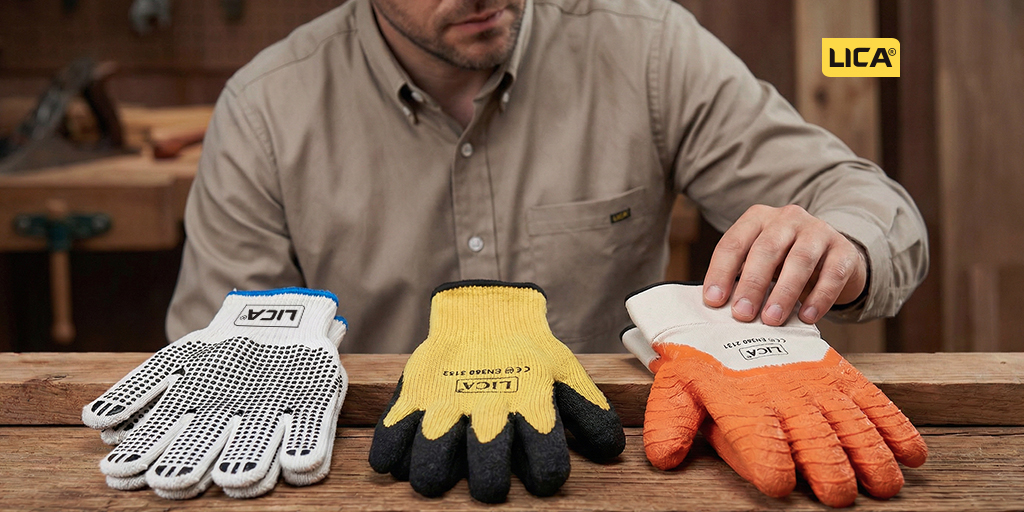
There is a recurring mistake in workplaces across the country: workers are wearing gloves, yet they still suffer hand injuries. The issue is usually not the lack of PPE availability. The problem is that the glove provided was not suitable for the specific risk they were exposed to.
Hands are the most affected body part in workplace accidents in Mexico. According to IMSS data from 2013–2022, hands and wrists account for 38.77% of all occupational injuries. In concrete terms, nearly 201,000 work absences due to hand injuries were recorded in 2023—more than 550 such accidents every day nationwide.
A figure that should be enough to rethink how hand PPE is selected in many companies.
Gloves Are Not Generic—And Neither Are Risks
The first mistake in glove selection is treating them as a uniform product. There are different glove families designed for completely different risks, and using the wrong one can create a false sense of protection that is more dangerous than wearing none at all.
The main types of risk that determine glove selection are:
Mechanical Risk: Cuts, Abrasion, Puncture, and Tear
This is the most common risk in manufacturing, construction, logistics, and metalworking.
For material handling, metal parts, or tools, split leather gloves provide natural resistance to abrasion and tearing. At LICA, we offer models GCC (short) and GCL (long with sleeve) for extended forearm protection.
When higher precision and grip are required, coated gloves are the best option. Models GLNN (nylon with nitrile coating) and GLNSPANDEX9—both certified under EN 388—offer mechanical protection with greater flexibility and comfort.
For severe cut risks, the GLANTICUT model is a cut-resistant glove rated Level 5—the highest classification under EN 388—ideal for handling sharp materials such as sheet metal, glass, or industrial blades.
Thermal Risk: Heat, Flames, and Sparks
This risk is present in welding, foundry work, furnaces, and high-temperature processes.
The SG-5400 model from LICA is made of chrome-tanned split leather with double oil treatment and padded inner lining, sewn with Kevlar thread. It is specifically designed for manual welding and metal cutting.
For exposure to sparks in electrical installation or maintenance with moderate heat, the B182RG-L model—a cowhide glove with split leather cuff and elastic wrist—is a lighter, more versatile alternative.
Chemical Risk: Contact with Oils, Paints, Petroleum Derivatives, and Grease
Here, glove material is critical, as not all synthetics protect against all chemicals.
The GLNA9 model, featuring a nitrile coating over cotton and EN 388 certification, provides resistance to oils, paints, and petroleum derivatives. It is a solid choice for automotive mechanics, industrial maintenance, and lubrication-related tasks.
For general handling with liquid exposure risk, the GLLATPS10 model—a canvas glove with latex coating—offers good grip and protection against moisture and water-based substances.
Electrical Risk: Shock and Arc Flash
The only gloves that protect against this risk are dielectric gloves, made from natural or synthetic rubber and classified by voltage levels.
A split leather glove does not provide electrical insulation on its own. However, for tasks where the main risk is sparks and moderate heat—not high voltage—models A182RG and A184RG from LICA, with leather palm and split leather back, are designed for electricians working in installation and construction.
Special Mechanical Risk: Vibration and Impact
Operators of drills, grinders, or pneumatic hammers face a commonly overlooked risk: sustained vibration and impact on the back of the hand.
The GLANTIB10 model features an anti-vibration system in the foam nitrile palm and impact protection on the back, specifically designed for these applications.
Biological Risk: Contact with Fluids, Microorganisms, or Contaminated Materials
This risk is common in the food industry, waste management, and healthcare.
Latex, nitrile, or vinyl gloves—generally disposable—are used to create an effective barrier against infectious agents. NOM-017-STPS-2024 clearly states that gloves must not be shared between workers and should be strictly for personal use.
What to Check Before Choosing
Beyond the type of risk, other factors determine whether a glove truly performs its function.
Fit and sizing are critical. A glove that is too large reduces dexterity and may get caught in machinery. One that is too small causes hand fatigue and is often removed by the worker. Comfort is not a luxury—if the glove is uncomfortable, it will not be worn, and all protection is lost.
Certification ensures the glove has been tested under real conditions. In Mexico, NOM-017-STPS-2024 requires PPE to be certified by an accredited body. For mechanical risks, the most common certifications are EN 388 and NMX-S-040, the latter specific to split leather gloves.
Service life also matters. A glove with holes, open seams, or degraded material no longer provides protection, even if it is still being used. Regulations require keeping PPE replacement records for this reason.
The LICA Glove Portfolio
Understanding the risk is the first step. The second is having access to a supplier that offers the right option for every situation.
At LICA, we provide a complete line of gloves—split leather, leather, coated, and specialty—to cover the main risks in Mexican industry. All products meet the required certifications and are available for companies and distributors nationwide.
Because real hand protection starts with a good purchasing decision—and that decision starts with understanding the risk.
Do you need guidance to choose the right glove for your industry? Contact us, we’ll be happy to assist you.
Sources
IMSS — Occupational Risk Statistics, 2013–2022
Mexico City Ministry of Health — International Hand Surgery Congress, 2021
Manufactura LATAM — Split Leather Gloves for Industrial Use, 2023
STPS — NOM-117-STPS-1995, Protective Gloves Against Chemical Substances
NMX-S-018-SCFI — Rubber Gloves for Electrical Use
NOM-017-STPS-2024 — Personal Protective Equipment: Selection, Use, and Handling