


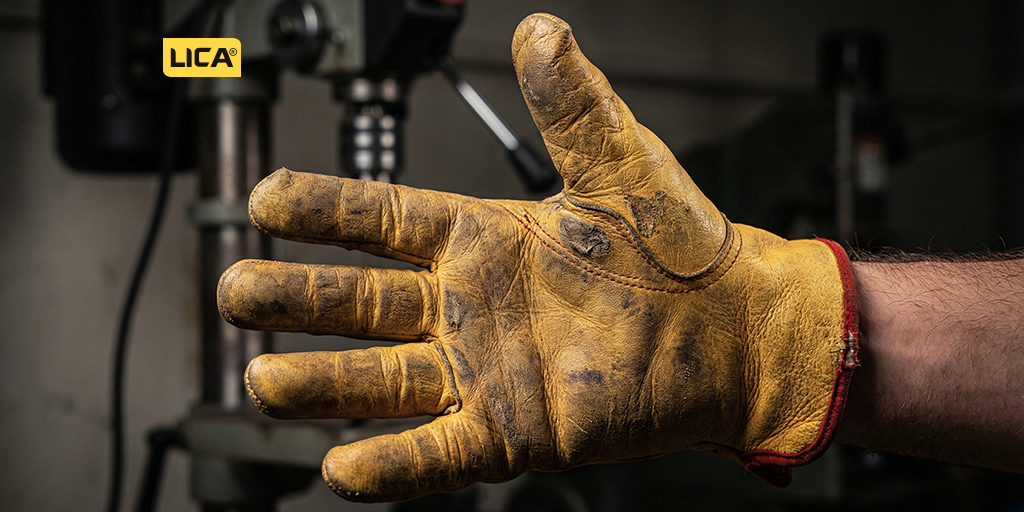
There is a widespread habit in workplaces that may seem like cost-saving, but actually represents a risk: using gloves until they break. As long as there is no obvious hole, they continue to be used. The problem is that safety gloves can lose their protective capacity long before the damage becomes visible to the naked eye.
A worn-out glove does not protect. And the most dangerous part is that the worker wearing it believes it does.
Do Gloves Have an Expiration Date?
Unlike other PPE such as helmets, safety gloves do not have a fixed expiration date. Their service life depends on three factors: the material they are made of, the conditions they are exposed to, and the intensity of daily use.
A split leather glove used in continuous welding for eight hours a day does not have the same lifespan as a nitrile glove used for occasional part inspection a few hours a week.
What regulations do establish is the obligation to manage replacement. NOM-017-STPS-2024, in force since September 2025, requires employers to have written procedures for PPE use, inspection, replacement, maintenance, and disposal, as well as documented records of each replacement.
This means that “replacing them when they break” is no longer sufficient—neither from a legal standpoint nor from a real safety perspective.
Signs It’s Time to Replace Your Gloves
Beyond timelines, there are clear warning signs that should never be ignored:
Visible Damage
Punctures, cuts, tears, or open seams are the most obvious signs. Any opening in the material eliminates the protective barrier in that area—usually where exposure to risk is highest.
Stiffness or Loss of Flexibility
Split leather and synthetic materials degrade with repeated exposure to heat, oils, or chemicals. When a glove becomes stiff, dexterity is reduced, physical effort increases, and the risk of accidents rises.
Discoloration or Persistent Stains
For gloves exposed to chemicals, discoloration may indicate that the material has been penetrated or weakened. A glove that has absorbed a solvent or acid may have lost its chemical resistance, even without visible perforations.
Poor Fit
A glove that has stretched, deformed, or no longer fits properly is just as dangerous as a damaged one. Loose gloves can get caught in machinery or reduce tool control, while overly tight gloves cause fatigue and restrict circulation.
NOM-017-STPS-2024 explicitly states that PPE must match the worker’s size and measurements, as improper fit can create additional risks.
Persistent Chemical Odor
In gloves used for handling solvents, paints, or acids, a lingering odor—even after cleaning—is a sign that the material has been permeated. At that point, the glove no longer provides the chemical barrier it was designed for.
After an Incident
If the worker has experienced significant exposure to a hazardous substance, a major spark, a cut that nearly penetrated the glove, or any high-risk situation, the glove must be removed and evaluated before being used again—even if no visible damage is present.
The Mistake of Washing Gloves That Shouldn’t Be Washed
Another factor that reduces glove lifespan—and one that many companies overlook—is improper cleaning.
Not all materials can be washed with soap and water. Split leather gloves, for example, may harden and lose flexibility if cleaned incorrectly. Rubber or nitrile gloves may degrade when exposed to certain detergents.
Always follow the manufacturer’s instructions for cleaning and storage. Gloves should be kept in a dry, cool place away from direct sunlight to preserve their properties.
What the Standard Requires and What It Means for Businesses and Distributors
For companies, keeping a glove replacement record is not bureaucracy—it is legal protection during a labor inspection and, more importantly, proof that worker safety is being actively managed.
NOM-017-STPS-2024 requires this record to include the type of equipment provided, delivery and replacement dates, and the worker’s signature.
For distributors, understanding these replacement cycles is a direct business opportunity: a customer properly advised on the real lifespan of their gloves becomes a recurring buyer, trusts their supplier, and is better prepared for regulatory inspections.
At LICA, We Have the Next Pair Ready When the Previous One Reaches Its Limit
Having a reliable supplier with available inventory is just as important as knowing when to replace gloves.
At LICA, we offer a complete line of gloves for mechanical, thermal, chemical, and specialized risks—from split leather models like GCC and GCL to the Level 5 cut-resistant GLANTICUT, along with our range of nitrile- and latex-coated gloves.
All products are certified and available for companies and distributors throughout Mexico.
Because protection that is interrupted is no longer protection.
Do you want to implement a glove replacement program for your company or expand your product catalog as a distributor? Contact us, we’re here to help.
Sources
Ministry of Labor and Social Welfare (STPS) — NOM-017-STPS-2024, published in the Official Gazette on March 28, 2025
IMSS — Occupational Risk Statistics, 2013–2022
Work City — Signs of Wear and Replacement of Safety Gloves, 2025
EPP México — PPE Expiration: Service Life and Replacement, 2025
Santamarina + Steta — Analysis of NOM-017-STPS-2024, April 2025