

It is a common scene in many industrial plants: someone in purchasing buys a box of disposable face masks, hands them out to personnel exposed to dust or fumes, and considers the matter of respiratory protection resolved. The problem is that a face mask and a respirator are not the same, and that confusion — though it may seem minor — can be leaving workers without the protection they actually need.
Both products cover the nose and mouth. Visually, they may look similar. However, the difference between the two determines whether a worker is genuinely protected against the contaminants in their environment, or only has a cosmetic barrier against a real risk.
Face Mask: What It Is and What It Actually Does
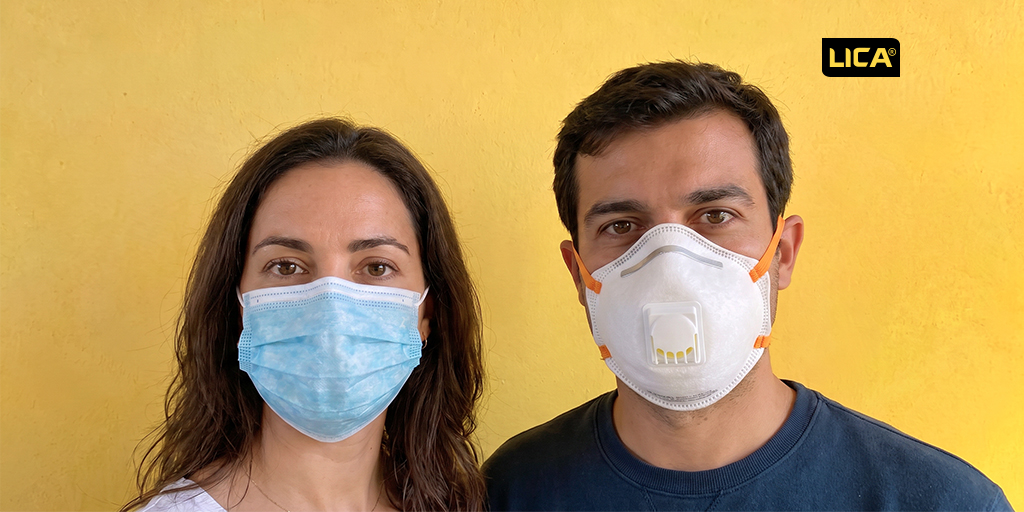
The face mask, also called a surgical mask, was originally designed for medical environments. Its main function is to contain the large respiratory droplets emitted by the wearer, thereby protecting others. Secondarily, it offers some barrier against large splashes and droplets from outside.
What the face mask does not do is seal against the face. Its fit is loose by design, which allows air — and the fine particles or aerosols it may contain — to enter and exit through the sides without passing through the filtering material. Surgical masks are not respiratory protection devices, unlike respirators, precisely for this reason. They are not designed or certified to protect the wearer against industrial contaminants suspended in the air.
Respirator: What Makes It Different
A respirator, on the other hand, is specifically designed to reduce the user’s exposure to particles or gases through a tight seal against the face and a certified filtering medium. The key difference is not just the material, but the fit: when properly fitted and verified, only minimal leakage occurs around the edges, ensuring that the inhaled air actually passes through the filter.
In Mexico, respirators against harmful particles are regulated by NOM-116-STPS-2009, which establishes the characteristics, minimum requirements, and test methods these devices must meet. A product that does not comply with this standard — or with equivalent international standards such as NIOSH N95 or EN149 — cannot be considered certified respiratory protection, regardless of how it is marketed or what it looks like.
The Difference in Numbers
A properly fitted N95 respirator filters at least 95% of airborne particles, including small particles and aerosols. A conventional face mask, on the other hand, may block large splashes and droplets, but does not provide reliable protection against aerosol particles, precisely because of the loose fit between the mask and the face.
This difference is not a minor technical nuance. In an environment with metal dust, welding fumes, paint mists, or fine process particles, a face mask can give the worker — and the company — a false sense of compliance, while actual exposure continues unchecked.
When to Use Each One
The face mask has its place, but that place is not industrial respiratory protection. It is suitable for general hygiene contexts, biosecurity control in administrative areas, or as a courtesy measure in shared spaces. It does not replace respiratory PPE in any position where real exposure to airborne contaminants exists.
The respirator is the correct equipment when there is exposure to dust, fumes, mists, organic vapors, or gases at concentrations that pose a risk to respiratory health. LICA offers different certified options depending on the level of protection required: the CHML10 mask, N95 for solid particles with three-layer construction, for exposure to dust and metal fumes; the CHML11, with exhalation valve and FFP2 NR classification, for greater comfort during long shifts; and the CHRL200 half-face respirator, compatible with the CHF03 cartridge for organic vapor and acid gases, when the risk is not just particles but chemical contaminants in gaseous phase.
What the Confusion Costs the Company
Beyond the direct risk to worker health, providing face masks where the standard requires a certified respirator represents a concrete legal exposure. NOM-017-STPS-2024 requires employers to select PPE based on the real risk of the position and to have verifiable certification from an accredited body. In the event of a STPS inspection, a face mask provided as a substitute for certified respiratory protection does not meet this requirement, and the company is exposed to sanctions. In the case of a respiratory occupational illness, the legal exposure is even greater.
For distributors, this confusion is also an opportunity for advisory sales. A client who understands the difference between the two products makes better purchasing decisions, reduces their regulatory risk, and trusts the supplier who explained the difference before it became a problem.
How to Verify Real Respiratory Protection Is Being Used
Before assuming a position is covered, it is worth checking three things: whether the product provided has visible NOM, NIOSH, or EN certification on the packaging; whether the design includes an adjustable facial sealing mechanism, not just loose elastic bands; and whether the filter type corresponds to the actual contaminant present — particles, organic vapors, or both.
At LICA, we offer a complete line of certified respiratory protection — from N95 and FFP2 filtering masks to half-face respirators and full-face masks with specific cartridges — available for companies and distributors throughout Mexico. Because the difference between a face mask and a respirator is not a matter of appearance: it is the difference between complying on paper and truly protecting.
Want to verify whether the respiratory protection your personnel use meets NOM-116-STPS-2009 requirements? Contact us or browse our complete respiratory protection line.
Sources:
- Mexican Social Security Institute (IMSS) — Face Masks: What You Need to Know, 2021
- Ministry of Labor and Social Welfare (STPS) — NOM-116-STPS-2009, Air-purifying respirators against harmful particles
- STPS — NOM-017-STPS-2024, Personal Protective Equipment
- Moldex — Technical comparison between respirators and surgical masks
- U.S. Food and Drug Administration (FDA) — Differences between masks and N95 respirators