


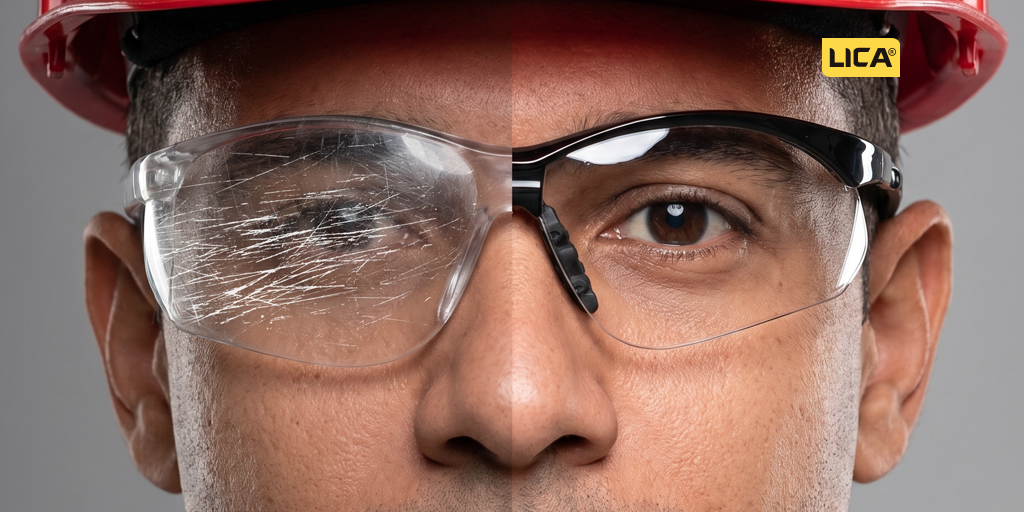
There is a silent but widespread criterion for replacing safety glasses in companies: wait until they break. As long as the worker can put them on and see through them, the glasses still “work.” The problem is that safety glasses can stop protecting long before they show obvious damage — and continuing to use them in that condition is not cost savings. It is unmanaged risk.
Unlike other PPE whose deterioration is more obvious — a boot with a detached outsole, a torn glove — safety glasses tend to degrade gradually and quietly. Scratches accumulate, the lens loses light transmission, the frame loses its fit. None of those changes stop the worker from putting them on. All of them, however, reduce their actual protective capacity.
Do Safety Glasses Have a Defined Service Life?
There is no universal expiration date for safety glasses. Their service life depends on the lens material, intensity of use, environmental conditions, and the care they receive. A pair used in metalworking with constant exposure to particles and heat does not last as long as one used in technical office supervision.
As a general reference, manufacturers and international safety organizations recommend inspecting safety glasses every six months under intensive use and replacing them at any sign of deterioration, regardless of how much time has passed. What the standard does establish is the obligation to manage this formally. NOM-017-STPS-2024, in force since September 2025, requires employers to have documented procedures for PPE inspection, maintenance, replacement, and final disposal, including delivery records with the worker’s signature. Replacing glasses only when they break does not meet this requirement.
Signs That Indicate It Is Time to Replace Safety Glasses
Scratches on the lens. This is the most common sign and, at the same time, the most underestimated. Surface scratches reduce visual clarity, create annoying glare from direct light sources, and in high-luminosity environments or nighttime work, compromise the worker’s perception. When scratches cover the central vision zone or make it difficult to read instruments, the glasses must be replaced. An anti-scratch coating extends service life, but does not make it indefinite.
Opaque, yellowed, or low-transmission lens. Prolonged exposure to ultraviolet light, heat, or certain chemicals can degrade polycarbonate and cause a gradual opacity that reduces the amount of light reaching the eye. This deterioration directly affects visibility in low-light environments and represents a concrete risk in operations involving machinery or moving vehicles.
Persistent fogging that does not respond to treatment. Glasses with factory anti-fog treatment can lose that property over time, especially if cleaned with abrasive materials or exposed to solvents. When fogging becomes frequent and immediate upon putting the glasses on, their functionality in humid or temperature-variable environments is compromised.
Deformed frame or loss of fit. A frame that no longer fits correctly to the face creates lateral gaps where particles, splashes, or radiation can enter. ANSI Z87.1 requires effective lateral protection; a deformed frame that leaves the sides exposed fails this requirement even if the lens is intact. Furthermore, glasses that do not stay in the correct position cause visual fatigue and increase the likelihood that the worker will remove them during the shift.
Broken, loose, or low-grip temples. The temples are the element that keeps the glasses in place during movement and physical effort. A broken or very loose temple turns the glasses into an accessory that falls off, shifts, or simply does not get used. In operations involving machinery, tools, or work at height, glasses that slip out of the visual field at the wrong moment can lead to an accident.
Cracked or inflexible nose bridge. The nose bridge determines how the weight of the glasses is distributed and their position on the face. When it cracks or loses flexibility, the fit becomes uncomfortable, the glasses shift downward, and lateral protection loses effectiveness. Models such as the LICA-TRAN-I include an adjustable nose bridge precisely to adapt to different facial profiles and extend wearing comfort. However, when this component fails, the glasses must be replaced.
After a significant impact. If the glasses received a direct impact from a particle, tool, or projectile — even without a visible fracture — they must be removed from service and evaluated before being used again. Polycarbonate can develop internal microfractures that are not detectable to the naked eye but reduce its absorption capacity against a second impact. Glasses that have already fulfilled their protective function in one incident do not guarantee the same level of protection in the next.
Damage to special coatings. Glasses with UV filters, REVO coatings, or anti-fog treatments depend on the integrity of those layers to function correctly. When coatings show bubbles, peeling, or permanent stains, the glasses lose the additional properties for which they were purchased. A RUNNER-SM-AZ model with a damaged REVO coating, for example, no longer provides the certified UV400 protection it was designed for.
How to Extend Service Life Without Compromising Protection
Correct storage and cleaning make a significant difference in the durability of safety glasses. Storing them in their case or soft pouch prevents scratches during transport. Cleaning them with a soft cloth and clean water — never with clothing, paper, or solvents — preserves the coatings. Keeping them away from direct heat sources prevents frame deformation and polycarbonate degradation.
Proper care extends service life, however, it does not make it indefinite. When any of the signs described above are present, replacement is the only correct decision.
What This Means for Companies and Distributors
For companies, having a periodic glasses inspection program is not just good practice — it is a legal obligation under NOM-017-STPS-2024 and the evidence that protects the organization during inspections or in the event of an accident. This program must include inspection frequency, removal criteria, the person responsible for carrying out inspections, and documentary records of each replacement.
For distributors, understanding these replacement cycles is a direct business opportunity. A client who understands the real service life of their glasses is a client who purchases regularly, trusts their supplier, and is normatively protected. Replacement is not just a sale: it is value-added service.
At LICA, we offer a complete line of certified safety glasses — models for general plant use, REVO-coated options for outdoor work, and Safety Girl variants for female workers — all available for companies and distributors throughout Mexico. Because protection that deteriorates without being replaced is no longer protection.
Want to establish an eye protection replacement program for your company or expand your catalog as a distributor? Contact us or browse our complete safety glasses line.
Sources:
- Ministry of Labor and Social Welfare (STPS) — NOM-017-STPS-2024, Personal Protective Equipment
- American National Standards Institute — ANSI Z87.1, Occupational and Educational Personal Eye and Face Protection Devices
- IMSS — Occupational risk statistics, eye injuries, 2023
- European Safety Federation — Guidelines on service life of eye protection PPE, 2022