
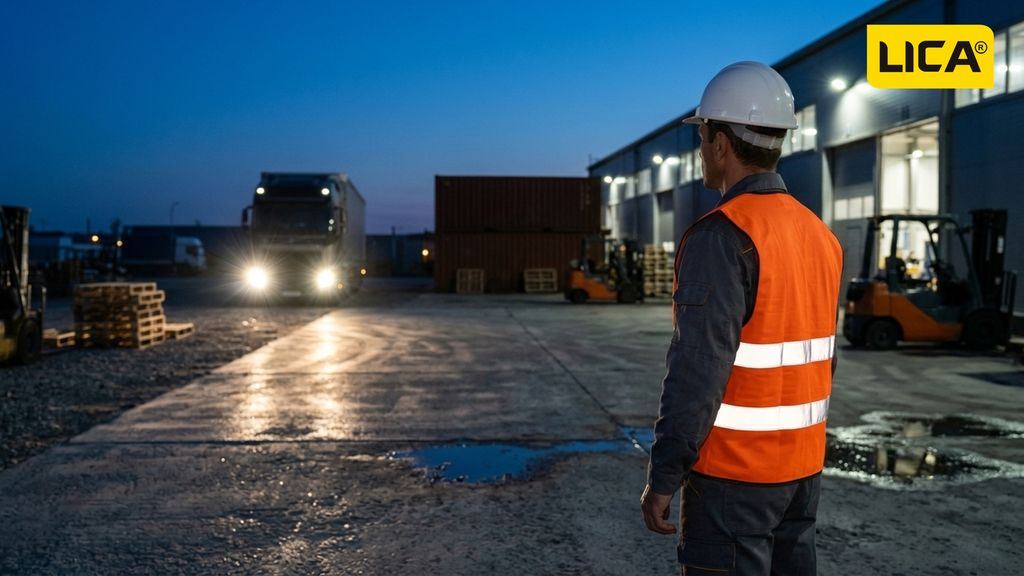
When shifts start before sunrise or end after sunset, visibility during low-light shifts stops being a detail. It becomes a risk factor. In Guadalajara, for example, November and December averages place sunset at around 6:15 p.m. and sunrise between 7:00 and 7:30 a.m.
That means a normal shift can cross two periods of dim light. At the same time, the year-end rush usually increases the movement of vehicles and equipment in yards, loading docks, and roadways. More traffic and less light is a combination worth addressing before an incident occurs.
What Happens to Visibility During Low-Light Shifts
When lighting drops, drivers have less time to recognize a person. A research review by Wood and King, published in the Journal of the Australasian College of Road Safety, notes that pedestrians can be up to seven times more likely to be involved in a fatal collision at night than during the day. The fatal crash data the study reviews also place night-time construction at roughly five times more hazardous than daytime construction.
According to the authors, the increase in night-time pedestrian crashes is mainly explained by reduced illumination. It is not so much due to other factors, such as fatigue or alcohol. In other words, at night drivers often fail to recognize the worker from a safe distance.
NMX-S-061-SCFI-2017 reflects this in its definition. It describes high-visibility clothing as clothing that makes the wearer stand out in natural or artificial light and in low-visibility areas, such as dim light, darkness, rain, or fog.
Who Is Most Exposed
- Logistics and distribution: loading docks, maneuvering yards, and loading areas with forklifts and trucks in motion, especially during the year-end peak season.
- Construction and roadwork: personnel working near traffic, with shifts that extend into the evening.
- Railway and field services: outdoor activities with little artificial lighting.
- Security and maintenance: rounds at dawn or dusk in areas with vehicle traffic.
- Early shifts: personnel who start before the sun comes up, including suppliers and visitors.
Visibility Checklist Before Year-End
1. Map shifts and positions. Identify who works before 7:30 a.m. or after 6:00 p.m., and in which areas. That map defines where visibility is critical.
2. Audit existing vests. Check the reflective tape, color, seams, and closures. A vest with dull or peeling tape no longer does its job, even if it looks intact.
3. Choose the model according to the task. For roadwork and yards, the CLR2001 and the CLR3001 have 5 cm tape. For supervision with a radio and badge, the CLR5000 includes a cell phone or radio pocket and a badge holder. For visitors or suppliers, the CLREF goes on in seconds over any garment. In addition, if low light coincides with rain or fog, LICA’s JSPHV-L rain suit incorporates high-visibility reflective tape.
4. Complement with signage. The vest makes the person visible, but it does not separate pedestrians from vehicles. For that, the Safety Signage line includes low and high barriers with reflective strips to mark off risk areas.
5. Check the lighting. Verify that loading docks, entrances, and parking areas have enough light, and replace any fixtures that fail. No vest replaces a well-lit area.
6. Train and document. Explain to personnel that the vest must be closed and visible, not covered by tools or harnesses. In addition, record every delivery and replacement.
What the Regulations Say
NOM-017-STPS-2024, in force since September 2025, requires employers to select PPE based on the risk of each position and to train personnel. It also requires keeping records of delivery and replacement. If a position’s risk includes low light and vehicle traffic, visibility is part of that selection.
At LICA, we offer vests for different exposure profiles, from lightweight reflective bands to rescue vests with pockets. We also have traffic signage to mark off risk areas. Everything is available for companies and distributors throughout Mexico.
The days will stay short until winter ends. What you can decide is that your personnel stay visible.
Want to review your personnel’s visibility before year-end? Contact us or browse our vest line.
Sources:
- Wood, J. M. and King, M. J.: Research initiatives to improve the visibility and hence safety of road workers at night-time. Journal of the Australasian College of Road Safety, 2010 (via SWOV)
- Ministry of Economy: NMX-S-061-SCFI-2017, Safety – High-visibility clothing for professional use
- STPS: NOM-017-STPS-2024, Personal Protective Equipment
- Climate averages for Guadalajara, Jalisco: sunrise and sunset times (adonde-y-cuando.es)