


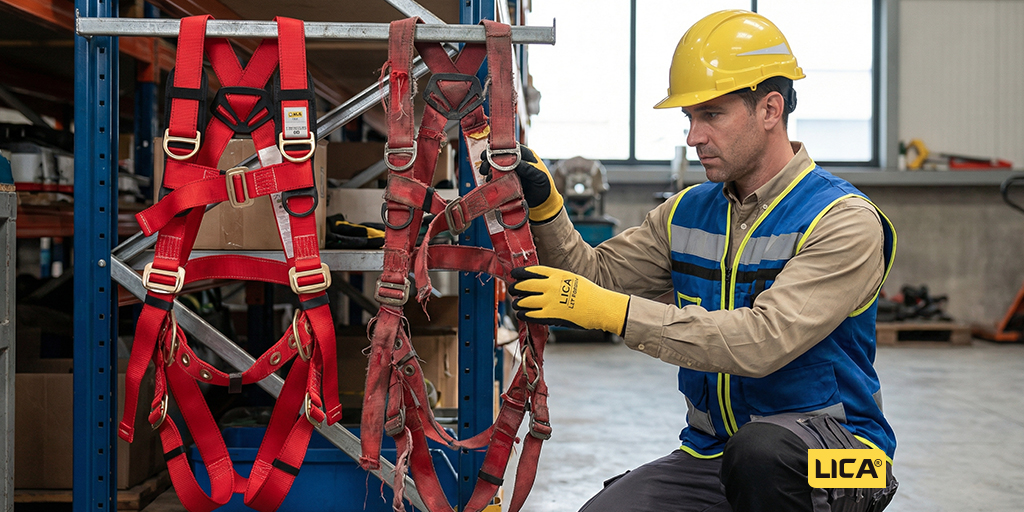
Master Safety Guide: The Art of Caring for Your Equipment
Did you know that a tiny nick on a strap could be the difference between a minor scare and a tragedy? In the world of work-at-heights, your gear is your best ally and, literally, your life insurance. Many professionals underestimate natural wear and tear, but Harness maintenance and inspection: extends service life and protects the worker in a real and measurable way.
It is not just about complying with a technical standard, but about ensuring that every team member returns home safe and sound at the end of the day. At LICA, we understand that safety is an investment in peace of mind and operational efficiency. Therefore, we have prepared this guide so you can master the care of your protection tools.
Join me to discover how to keep your harnesses in impeccable condition. You will learn to identify hidden risks and maximize the return on your investment in personal protective equipment.
1. The Vital Importance of Daily Inspection
Real safety begins long before your feet leave the ground. A fall protection equipment inspection shouldn’t take more than five minutes, but its value is immeasurable for occupational risk prevention.
Detecting a friction burn, a loose thread, or a frayed seam in time prevents fatal accidents. An industrial safety harness is designed to withstand incredible forces, but factors like sun, humidity, and chemicals are silent enemies that degrade fibers.
Following OSHA regulations and ANSI Z359 standards, daily checks are not optional. Ignoring minor damage is playing Russian roulette with physical integrity. A worker who fully trusts their gear is, undoubtedly, a more productive and focused worker.
2. Step-by-Step: How to Perform a Technical Inspection
To perform an effective harness review, you must follow a logical order. First, hold the equipment by the dorsal D-ring and let the straps fall freely to verify there are no permanent twists in the material.
Visually observe every inch of the webbing looking for cuts or color changes. An expert tip is to bend the strap into a “U” shape; this exposes potential cracks in the internal fibers of the fabric that are not visible to the naked eye. Metal hardware must be free of deformations, corrosion, or sharp edges.
Pay special attention to quick-connect buckles. These should close with a firm “click” and not slide under pressure. Also, remember that if the safety labels are illegible, the equipment loses its traceability and must be removed from service immediately for administrative safety.
3. Cleaning and Storage: The Secret to Durability
Harness maintenance and inspection: extends service life and protects the worker through correct hygiene habits. Much equipment is ruined prematurely by using harsh solvents or corrosive chemicals that weaken the high-tenacity polyester.
For proper safety equipment cleaning, use only lukewarm water and a neutral soap. Rub gently with a sponge to remove grease or paint. Never use industrial washing machines or dryers, as extreme heat alters the elastic properties of synthetic fibers.
Harness storage is the final touch. They should be kept in a cool, dry place away from UV rays. Avoid leaving them in the bed of a truck or in places with chemical vapors. An individual hanger is ideal to prevent straps from suffering unnecessary deformations over time.
4. When to Say Goodbye: Service Retirement Criteria
Knowing when to retire a full-body harness is vital. Generally, harness service life is estimated at 5 years, though this varies depending on usage intensity and the work environment. If the gear has arrested a fall, its removal must be immediate and definitive.
Look for critical signs such as burnt seams or frayed threads at load points. Any homemade alteration, such as piercing straps to add accessories, voids the harness certification. If the webbing feels stiff or “glassy,” it is a sign that the polymers have degraded due to chemicals or solar radiation.
Remember that Harness maintenance and inspection: extends service life and protects the worker, but it doesn’t work miracles on old gear. Do not skimp on renewing your PPE when impact indicators have been activated. The safety of your human team will always be the best investment you can make.
Conclusion: Your Safety is Our Priority
As we have seen, Harness maintenance and inspection: extends service life and protects the worker in a comprehensive way. From technical review to strategic storage, every step counts toward ensuring a hitch-free high-altitude operation.
Industrial safety is not just a matter of legal compliance, but a culture of mutual care. By applying these tips, you protect your investment and, most importantly, the lives of those who trust your leadership. At LICA, we are ready to advise you with the best equipment on the market.
References and Citations:
OSHA 1910.140: Personal fall protection systems standards.
ANSI/ASSP Z359.11: Safety requirements for full body harnesses.
NOM-009-STPS-2011: Safety conditions for performing work at heights (Mexico).