
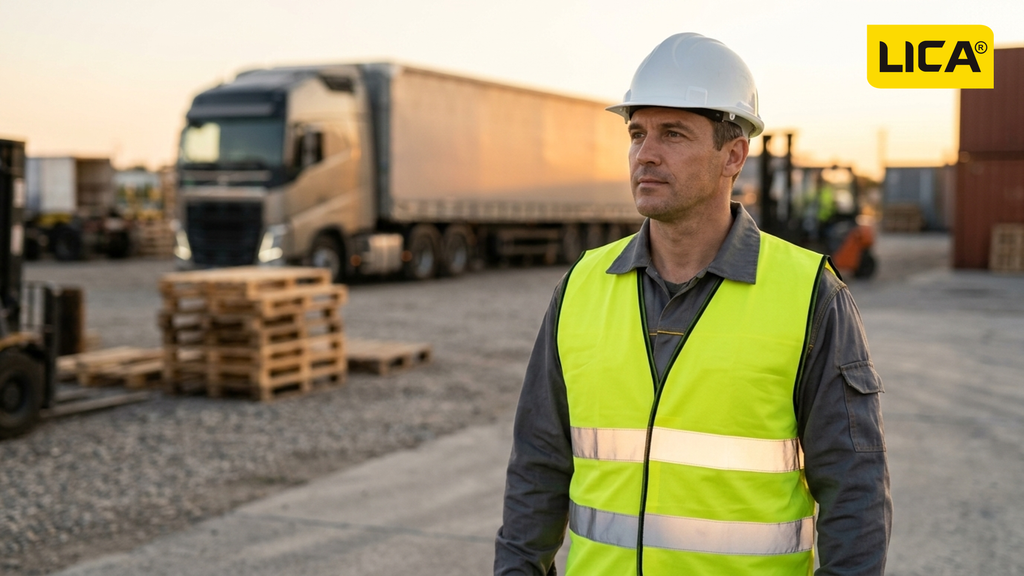
A vest seems like a simple garment. However, the difference between choosing well and choosing out of habit shows up exactly when a driver needs to see a worker in time. That is why choosing high-visibility vests according to the work environment, and not just by color, is a decision that directly affects safety.
In many companies, vests are handed out to all personnel equally. As a result, someone working in a yard with heavy traffic wears the same model as someone who only occasionally moves through a warehouse. These are different risks, and therefore they require different solutions.
What Makes a Vest High-Visibility?
Visibility depends on two elements working together. During the day, the fluorescent color of the background material stands out against the surroundings. At night or in low light, retroreflective tape sends the light from a driver’s own headlights back toward them.
In Mexico, the technical reference is NMX-S-061-SCFI-2017, “Safety – High-visibility clothing for professional use.” It applies to workers exposed to being struck by moving vehicles or equipment, in low-visibility conditions or complex traffic areas. Some examples are highways, ports, airports, mines, and construction sites. Unlike a NOM (a mandatory Mexican Official Standard), an NMX is voluntary. Even so, it works as the technical benchmark for evaluating a garment.
For the background material, the standard contemplates three fluorescent colors: yellow, orange, and red.
Visibility Classes: Which One Fits Your Operation?
The standard groups high-visibility clothing into three classes. The higher the class, the larger the minimum area of material and the wider the reflective bands: 25, 35, and 50 mm, respectively.
- Class 1: for activities with traffic that does not exceed 40 km/h, with good separation between the worker and vehicles, and uncomplicated backgrounds. For example, personnel who guide vehicles in parking areas or who share space with warehouse equipment.
- Class 2: for higher risks, such as inclement weather, complex backgrounds, tasks that distract attention from traffic, or vehicles traveling faster than 40 km/h. The standard mentions road construction, utility work, railway workers, and emergency personnel.
- Class 3: for traffic that exceeds 80 km/h. This class requires background material on the torso, sleeves, and legs. Therefore, a vest alone does not reach it.
In addition, the standard requires the garment to carry a marked pictogram showing its class and performance level. Check that label before buying.
How to Choose High-Visibility Vests for Your Work Environment
Roadwork, construction, and night work. Here the main risk is traffic. The CLR2001 has 5 cm reflective tape on the front and back, vented mesh fabric, and side elastic bands. Its data sheet recommends it for vehicle traffic areas, road construction, and night work. For its part, the CLR3001 offers 5 cm tape on the chest and waist, a hook-and-loop closure, and four colors, including a high-visibility green.
Logistics, yards, and warehouses. With machinery and vehicles in motion, it helps to have a vest that goes on quickly and does not get in the way. The CLR3001 fits this profile well. In addition, the CLREF, with crossed 2″ reflective bands and a front buckle, works as a complement for visitors or staff with intermittent exposure.
Rescue, brigades, and emergency response. These positions need identification and carrying capacity. The CLR4001 incorporates a zipper, a badge holder, and tear-resistant fabric, in lime yellow and orange. The CLR5000 is the most complete in the line: it adds front pockets, a cell phone or radio pocket, and open sides with elastic straps.
Long shifts in warm weather. When physical effort is a factor, breathability matters. The CTB100 is made of 100% cotton and has open sides with elastic straps. By contrast, the CTB200 closes the sides to provide a more secure fit for activities with wind or constant movement.
A note about color. When the main risk is traffic, prioritize fluorescent colors and reflective tape. When the goal is to identify roles or areas, a variety of colors is useful. The data sheets for the CTB models and the CLR5000 describe them precisely for identification by role, area, or company. In those cases, nighttime visibility depends mainly on the reflective tape.
Other Factors You Should Not Overlook
Fit and size. All models in the line are one-size, so the fit depends on the hook-and-loop closure, elastic bands, or elastic straps. The standard requires that a vest have no horizontal gaps larger than 50 mm for the size it was designed for. A loose vest shifts, snags, and leaves areas uncovered.
Compatibility with other PPE. If the position uses a harness, hard hat, or rainwear, verify that the vest remains visible and is not covered by straps or tools.
Use limitations. The data sheets for the CLR and CTB models state that they are not suitable for welding, steel, metallurgical, or high-temperature environments, because the material is not flame-resistant. For those positions, you need a different solution.
Documentation. Request the data sheet and check that the label indicates class, performance level, and care instructions. If your operation requires a specific class, it is worth confirming this before equipping your personnel.
What NOM-017-STPS-2024 Requires
The standard, in force since September 2025, establishes that employers must select PPE based on a risk analysis for each position. It also requires training personnel in its use and keeping records of delivery and replacement. Therefore, choosing the right vest is not just good practice: it is part of the PPE program.
At LICA, we offer a line of vests for different work profiles, from lightweight reflective bands to rescue vests with pockets and badge holders. Each data sheet details the composition, tape width, and recommended use, so you can choose with clear information. All are available for companies and distributors throughout Mexico.
Choosing well is not a matter of color. It is a matter of making sure every worker is seen in time.
Need guidance on choosing the right vest for each position? Contact us or browse our vest line.
Sources:
- Ministry of Economy: NMX-S-061-SCFI-2017, Safety – High-visibility clothing for professional use
- Ministry of Labor and Social Welfare (STPS): NOM-017-STPS-2024, Personal Protective Equipment
- LICA: vest line data sheets (lica.mx)