

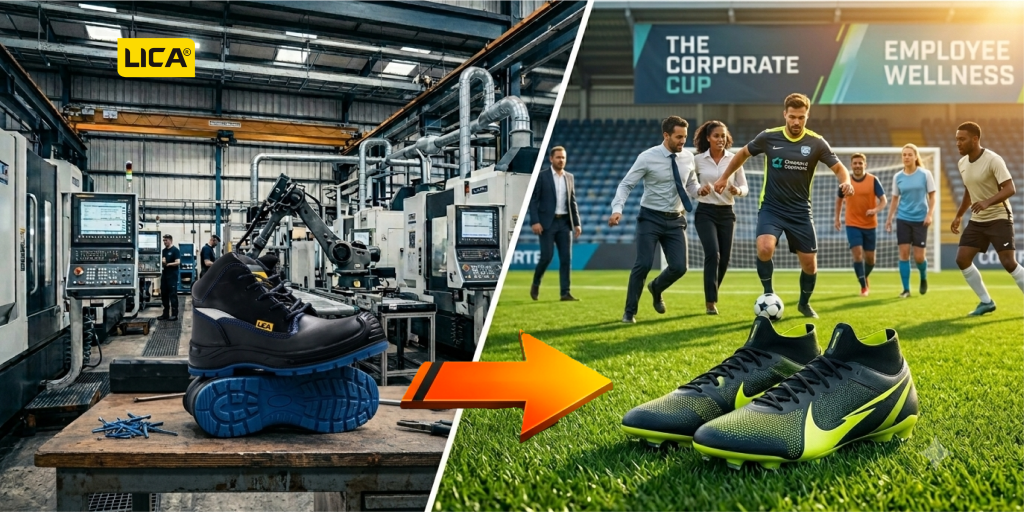
Every four years, the world turns its eyes to a playing field. While goals, plays, and records capture attention, something works silently beneath every athlete: their footwear. Decades of research in biomechanics, materials, and ergonomics have turned high performance sports footwear into a piece of engineering as sophisticated as any advanced technology equipment. What few people know is that much of that evolution also reached industry — and permanently changed what we understand by high performance work footwear.
The Starting Point: When Protection Was Not Enough
For decades, industrial safety footwear had a single objective: prevent injuries. Steel toe cap, thick outsole, rigid leather upper. It worked, but at a high cost: fatigue, injuries from prolonged use, and worker rejection — many preferred taking risks over enduring eight hours in uncomfortable boots. The problem was not protection. Nobody, however, had thought about performance.
Sport changed that conversation entirely. Athletic footwear manufacturers have spent over fifty years investing in understanding how the human foot moves, what forces act on it during sustained physical effort, and how intelligent design can improve performance and reduce injury simultaneously. As a result, those same principles, applied to the work environment, gave rise to the high performance safety footwear we know today.
Shared Technology: What Both Worlds Have in Common
Impact absorption.
An elite soccer player may take more than 10,000 steps during a match. Similarly, a worker on a manufacturing or construction site covers between 8,000 and 15,000 steps per shift. In both cases, the outsole is the first line of defense against the cumulative impact on knees, hips, and the spine. Consequently, the shock-absorbing midsole technology that sports footwear popularized — layers of materials with different densities that absorb and distribute impact — is now part of the design of the best industrial safety footwear models, including the dual-density polyurethane outsoles that characterize several models in the LICA line.
Ergonomics and arch support.
The foot in motion is not a flat surface. It has an arch that acts as a natural shock absorber and that, without adequate support, generates plantar fatigue and repetitive strain injuries. High performance sports footwear pioneered the design of lasts that respect foot anatomy. Modern industrial footwear adopted this principle as a result: a well-designed insole not only increases comfort, it also reduces absenteeism from musculoskeletal injuries — one of the main hidden costs of workplace accidents.
Lightweight and resistant materials.
The steel toe cap was the standard for decades. It worked, but it was heavy. Therefore, the development of composite and thermoplastic materials in the sports world — where every gram matters — opened the door to polyamide toe caps that offer the same level of impact protection at significantly lower weight. Several LICA dielectric models, such as the 105PLUS and the 109PLUS-SP, use polyamide toe caps precisely for this reason: certified protection without the weight that generates fatigue during long shifts.
Smart traction.
The outsole design of a soccer cleat is calculated to maximize grip on specific surfaces without compromising mobility. In the same way, an outsole designed for wet surfaces is not the same as one designed for dry concrete, metal surfaces, or irregular terrain. The geometry of drainage channels, compound hardness, and tread depth are technical decisions that ultimately determine whether the worker slips or not.
The Factor Sport Never Had to Consider: Certified Protection
This is where the paths diverge. A soccer player needs performance; an industrial worker, on the other hand, needs performance and regulatory protection. Safety footwear must meet technical standards that do not exist in the sports world: impact and compression resistance in the toe cap, penetration resistance in the insole, dielectric properties, and resistance to hydrocarbons or chemicals depending on the job risk.
In Mexico, NOM-113-STPS-2009 establishes these minimum requirements. Furthermore, no footwear that does not comply with this certification — however comfortable, lightweight, or technologically advanced it may appear — can be considered PPE. Certification is not a decorative seal: it is evidence that the footwear was subjected to real laboratory testing.
LICA: Where Technology and Protection Are Manufactured Together
At LICA, we apply European direct injection-to-upper technology to manufacture safety footwear in Guadalajara, Jalisco. This process, originally developed for the European high-performance industry, bonds upper and outsole in a single operation without seams or adhesives. As a result, the footwear is more durable, waterproof, and structurally sound than products made with traditional manufacturing methods.
The outcome is footwear that does not force the worker to choose between protection and comfort. Because on the playing field or on the factory floor, performance matters as much as safety.
Explore our complete line of safety footwear manufactured with European technology. Available for companies and distributors throughout Mexico. Contact us.
Sources:
- ILO — Ergonomics and human factors at work, 2022
- Ministry of Labor and Social Welfare (STPS) — NOM-113-STPS-2009
- Journal of Sports Sciences — Studies on impact and plantar fatigue in athletic footwear
- IMSS — Musculoskeletal occupational injuries, 2023