

The Silent Language That Saves Lives
In any industrial plant or warehouse, safety is the cornerstone of the operation and must never be negotiable. Given the presence of heavy machinery, chemical risks, and high-traffic areas, constant vigilance is essential. But who guides your personnel and visitors through this complex map of dangers? The answer is the silent, universal language of safety: signage.
Effective signage constitutes your company’s first line of defense. It operates 24/7, communicating risks and essential safety procedures without needing words. However, in practice, many companies make critical mistakes when implementing it, turning a vital protection system into a confusing obstacle. The result can be catastrophic: from a simple trip-and-fall to a severe accident. Keep in mind that Inspecciones laborales: lo que revisan y cómo prepararte (Workplace Inspections: What They Check and How to Prepare) scrutinize this issue strictly. Is your plant truly communicating safety clearly and in compliance with regulations? Continue reading to discover the most common errors and how LICA can help you turn them into protection successes.
The Hidden Cost of Poor Signage
Safety signage is often underestimated, viewed as a simple task. But it is a complex system, governed by strict international and local standards, whose objective is total uniformity in communication. When this system fails, the hidden cost skyrockets. A sign that is poorly placed or has an incorrect design (damaged or faded) is, ironically, worse than none at all, as it generates confusion and worker apathy.
Personnel stop perceiving the risk if the sign is irrelevant or illegible. One of the most frequent critical errors is visual saturation, where too many pictograms together cancel out their own effectiveness. Another common failure is chromatic inconsistency: not using the universally standardized colors (red for prohibition, yellow for warning) breaks global understanding and instinctive response. OSHA and local NOM-026-STPS clearly establish the exact colors, shapes, and symbols that must be used. Ignoring these regulations not only increases the risk of accidents in your facility, but also guarantees sanctions during any internal or external safety audit. Quality signage requires strategic planning and deep regulatory knowledge to ensure every safety message is received immediately and unambiguously.
LICA Quality for a Visually Safe Plant
To transform errors into successes and build a culture of prevention, your company needs a proactive and smart signage strategy. A safe plant is intrinsically an efficient and well-organized plant. The key lies in absolute clarity, constant visibility, and material durability.
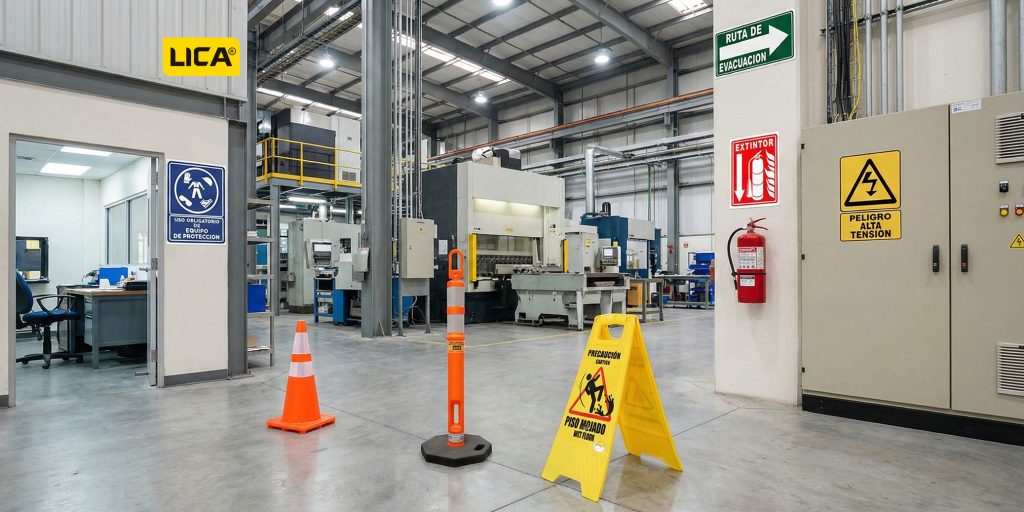
Signage not only warns; it also guides. For evacuation routes, photoluminescent signage is essential, guaranteeing visibility during a power failure. Another high-impact point is clearly defined area demarcation. Safety tapes and floor markings must unambiguously distinguish between pedestrian zones and circulation lanes for industrial vehicles. This reduces the probability of collisions and significantly improves workflow.
Uniformity in symbology is also essential for safety training: by using standardized signs of high quality, personnel respond by reflex. LICA offers comprehensive industrial signage solutions designed under STPS and ANSI standards. Our safety signs, which include prohibition, warning, and risk labels, are manufactured with resistant materials (such as styrene, PVC, and high-performance vinyls) and are long-lasting. Investing in this LICA quality ensures your signage won’t degrade prematurely due to humidity or chemicals. By upgrading your system, you demonstrate a superior commitment to occupational health, ensuring your plant passes Inspecciones laborales: lo que revisan y cómo prepararte with maximum confidence.
Your Step-by-Step Signage Audit
The time has come to take control and turn your signage into a true safety asset. A comprehensive and structured audit is required.
Here is your action plan to systematically avoid critical errors:
Risk Mapping: Identify every danger and specific regulatory requirement for your plant. An electrical risk, for instance, needs a precise warning sign.
Regulatory Verification: Ensure that the shape, color, and size of every pictogram strictly comply with NOM-026-STPS (or applicable OSHA standards). The law does not forgive ignorance!
Visibility Evaluation: Check the location and height of every piece of signage. Is it visible from all approaching angles of the worker?
Quality and Durability: Replace worn signage with materials resistant to chemical agents and industrial environment wear. LICA signage guarantees this superior durability.
Remember that effective signage is dynamic; it must be updated whenever procedures or plant layout changes. Start correcting those critical errors today. Contact LICA’s safety experts for industrial signage consultation and to acquire certified products. Your plant can communicate with the clarity and authority that safety demands.
Investing in Clarity
Safety signage is the universal language of prevention in the work environment. Its impact goes far beyond mere regulatory compliance; it lies in protecting human capital and ensuring operational continuity. Avoiding critical errors like visual saturation, chromatic inconsistency, or using deficient materials is essential. Clear, standardized signage that is well-located and backed by quality, certified products like those offered by LICA, not only prepares your company for Inspecciones laborales: lo que revisan y cómo prepararte, but also fosters a proactive and responsible safety culture. Clarity in communicating risk is, in this context, the best and most intelligent investment.
References
LICA.mx (2025). Signage Catalog: Prohibition, Warning, Obligation, and Fire Equipment Signs.
Secretaría del Trabajo y Previsión Social (STPS). NOM-026-STPS-2008, Colores y señales de seguridad e higiene, e identificación de riesgos por fluidos conducidos en tuberías.
International Organization for Standardization (ISO). ISO 7010, Graphical symbols — Safety colours and safety signs — Registered safety signs.