
LICA

Post English

Post English

FROM DUTY TO CONVICTION: DISCOVER HOW TO ENCOURAGE YOUR TEAM TO USE PPE WITHOUT RESISTANCE.

Why Is Your Team Taking Off Their Hard Hats or Goggles? If you are a safety manager, an area supervisor, or a business owner, you have experienced this frustration: your company invests in the best Personal Protective Equipment (PPE). Training sessions are conducted, and clear rules are established. Nevertheless, workers remove their goggles, do not adjust their harness, or view PPE as a nuisance. This resistance to PPE use is not defiance. It is a symptom of underlying issues within the organizational culture. If the team perceives the safety gear as uncomfortable or an obstacle to productivity, they will discard it. A safety breach of this nature exposes your personnel to serious injuries and the company to regulatory non-compliance (e.g., OSHA fines).  The true challenge is not to impose PPE, but to persuade the team of its personal value. Here we will reveal the definitive strategy on how to encourage your team to use PPE without resistance. Understanding the Psychology Behind PPE Resistance To overcome resistance, it is essential to understand the psychology and the practical reasons of the worker. Safety is a matter of human behavior, not just rules. Resistance to PPE primarily stems from three factors: 1. Equipment Comfort and Usability Many workers argue that PPE reduces their comfort and manual dexterity. Inadequate gloves can affect the ability to perform the task. Goggles that constantly fog up reduce visibility. If the equipment is an impediment rather than a tool, it will be avoided. It is crucial to prioritize ergonomics, certification, and ensure the correct size of the equipment for the specific task. 2. Culture and Leadership If supervisors or leaders do not use PPE, the implicit message to the team is that it is not truly necessary. The worker feels socially pressured to follow the group’s practices, even if they are unsafe. The supervisor’s attitude is the driving force of the safety culture. If leadership is not consistent, the team will not be either. Promoting peer-to-peer observation in a positive manner helps change the work environment. 3. Lack of Risk Awareness A worker who has never witnessed a serious accident may fall into overconfidence. Danger is perceived as abstract. Training must go beyond regulations. It should incorporate real examples and case studies that demonstrate the direct consequences of not using eye or hearing protection. This increases awareness and personal care. Making PPE the New Normal and a Cultural Standard Imagine a work environment where your employees adopt PPE voluntarily and disciplinedly. This guarantees legal compliance, minimizes accident rates, and increases productivity, as a safe worker is more efficient. Transforming resistance into commitment requires a change management strategy. How to encourage your team to use PPE without resistance moves from regulation to motivation. Strategies for Voluntary PPE Adoption Involve the team in selection: Allow employees to test different PPE models (goggles, gloves, hard hats). By giving them the power of choice over their protection tool, they feel more responsible for its correct use. This addresses the comfort issue. Lead by example: Supervisors and managers must be the most visible and disciplined users of PPE, establishing that safety is a non-negotiable priority. Consistency in leadership validates the social norm. Positive reinforcement and recognition: Implement a recognition program that celebrates safe behavior. Publicly recognize workers who demonstrate an exemplary attitude or report unsafe conditions related to PPE. Positive reinforcement is more effective than punishment. Practical and relevant training: Training sessions must include active practice where the worker experiences the value of protection. Use real examples and demonstrations to explain the why behind every rule and piece of equipment. Your Immediate Commitment to Cultural Change Cultural transformation demands continuous commitment and measurement. By implementing these strategies, you not only protect lives but also strengthen trust and respect within your workforce. The true solution to how to encourage your team to use PPE without resistance lies in empathy and education. Present PPE as a fundamental right and a personal protection tool, not just a legal requirement. Immediate practical steps: Request feedback: Conduct an anonymous survey on the comfort and usability of the current PPE. Designate safety ambassadors: Select respected workers to promote the correct use of the equipment in their areas. Audit your leaders: Check the consistency of your supervisors in PPE use. Their example is the starting point of the culture. Conclusion We have analyzed the psychological and practical barriers to PPE resistance and how to overcome them. The effective strategy focuses on involving the team in selection, leading by example, and using positive reinforcement. By mastering how to encourage your team to use PPE without resistance, you build a strong and lasting safety culture. A culture where the worker protects themselves by conviction, ensuring the health and future of your company. References Occupational Safety and Health Administration (OSHA). Compliance Assistance: Personal Protective Equipment (PPE). National Institute for Occupational Safety and Health (NIOSH). Guidance documents on worker safety and health. Behavior Based Safety (BBS) Studies.
Post English

SAFETY SIGNAGE: HOW TO AVOID CRITICAL MISTAKES IN YOUR PLANT

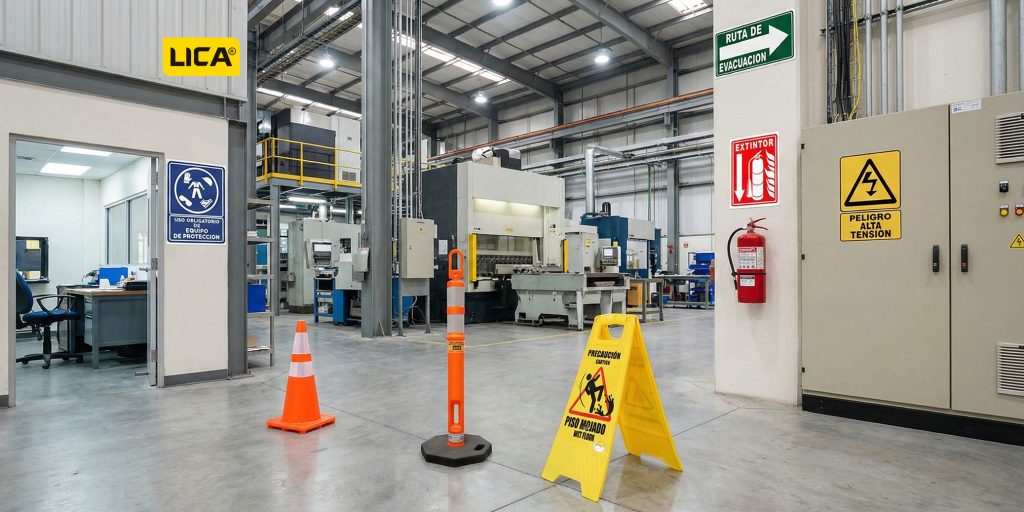
The Silent Language That Saves Lives In any industrial plant or warehouse, safety is the cornerstone of the operation and must never be negotiable. Given the presence of heavy machinery, chemical risks, and high-traffic areas, constant vigilance is essential. But who guides your personnel and visitors through this complex map of dangers? The answer is the silent, universal language of safety: signage. Effective signage constitutes your company’s first line of defense. It operates 24/7, communicating risks and essential safety procedures without needing words. However, in practice, many companies make critical mistakes when implementing it, turning a vital protection system into a confusing obstacle. The result can be catastrophic: from a simple trip-and-fall to a severe accident. Keep in mind that Inspecciones laborales: lo que revisan y cómo prepararte (Workplace Inspections: What They Check and How to Prepare) scrutinize this issue strictly. Is your plant truly communicating safety clearly and in compliance with regulations? Continue reading to discover the most common errors and how LICA can help you turn them into protection successes. The Hidden Cost of Poor Signage Safety signage is often underestimated, viewed as a simple task. But it is a complex system, governed by strict international and local standards, whose objective is total uniformity in communication. When this system fails, the hidden cost skyrockets. A sign that is poorly placed or has an incorrect design (damaged or faded) is, ironically, worse than none at all, as it generates confusion and worker apathy. Personnel stop perceiving the risk if the sign is irrelevant or illegible. One of the most frequent critical errors is visual saturation, where too many pictograms together cancel out their own effectiveness. Another common failure is chromatic inconsistency: not using the universally standardized colors (red for prohibition, yellow for warning) breaks global understanding and instinctive response. OSHA and local NOM-026-STPS clearly establish the exact colors, shapes, and symbols that must be used. Ignoring these regulations not only increases the risk of accidents in your facility, but also guarantees sanctions during any internal or external safety audit. Quality signage requires strategic planning and deep regulatory knowledge to ensure every safety message is received immediately and unambiguously. LICA Quality for a Visually Safe Plant To transform errors into successes and build a culture of prevention, your company needs a proactive and smart signage strategy. A safe plant is intrinsically an efficient and well-organized plant. The key lies in absolute clarity, constant visibility, and material durability. Signage not only warns; it also guides. For evacuation routes, photoluminescent signage is essential, guaranteeing visibility during a power failure. Another high-impact point is clearly defined area demarcation. Safety tapes and floor markings must unambiguously distinguish between pedestrian zones and circulation lanes for industrial vehicles. This reduces the probability of collisions and significantly improves workflow. Uniformity in symbology is also essential for safety training: by using standardized signs of high quality, personnel respond by reflex. LICA offers comprehensive industrial signage solutions designed under STPS and ANSI standards. Our safety signs, which include prohibition, warning, and risk labels, are manufactured with resistant materials (such as styrene, PVC, and high-performance vinyls) and are long-lasting. Investing in this LICA quality ensures your signage won’t degrade prematurely due to humidity or chemicals. By upgrading your system, you demonstrate a superior commitment to occupational health, ensuring your plant passes Inspecciones laborales: lo que revisan y cómo prepararte with maximum confidence. Your Step-by-Step Signage Audit The time has come to take control and turn your signage into a true safety asset. A comprehensive and structured audit is required. Here is your action plan to systematically avoid critical errors: Risk Mapping: Identify every danger and specific regulatory requirement for your plant. An electrical risk, for instance, needs a precise warning sign. Regulatory Verification: Ensure that the shape, color, and size of every pictogram strictly comply with NOM-026-STPS (or applicable OSHA standards). The law does not forgive ignorance! Visibility Evaluation: Check the location and height of every piece of signage. Is it visible from all approaching angles of the worker? Quality and Durability: Replace worn signage with materials resistant to chemical agents and industrial environment wear. LICA signage guarantees this superior durability. Remember that effective signage is dynamic; it must be updated whenever procedures or plant layout changes. Start correcting those critical errors today. Contact LICA’s safety experts for industrial signage consultation and to acquire certified products. Your plant can communicate with the clarity and authority that safety demands. Investing in Clarity Safety signage is the universal language of prevention in the work environment. Its impact goes far beyond mere regulatory compliance; it lies in protecting human capital and ensuring operational continuity. Avoiding critical errors like visual saturation, chromatic inconsistency, or using deficient materials is essential. Clear, standardized signage that is well-located and backed by quality, certified products like those offered by LICA, not only prepares your company for Inspecciones laborales: lo que revisan y cómo prepararte, but also fosters a proactive and responsible safety culture. Clarity in communicating risk is, in this context, the best and most intelligent investment. References LICA.mx (2025). Signage Catalog: Prohibition, Warning, Obligation, and Fire Equipment Signs. Secretaría del Trabajo y Previsión Social (STPS). NOM-026-STPS-2008, Colores y señales de seguridad e higiene, e identificación de riesgos por fluidos conducidos en tuberías. International Organization for Standardization (ISO). ISO 7010, Graphical symbols — Safety colours and safety signs — Registered safety signs.

Post English

STOP THE SHOCK: WHY LICA DIELECTRIC SAFETY FOOTWEAR IS THE INVESTMENT YOUR COMPANY NEEDS

The Invisible Danger Beneath Your Feet In the work environment, electricity is an invisible yet lethal threat. While many risks are obvious, the electric current silently lurks in cables and circuits. A simple mistake or accidental contact can lead to fatal electrocution or severe burns, with devastating consequences for the worker and the company. Industrial safety cannot afford oversights. Compliance with regulations and successfully passing Inspecciones laborales: lo que revisan y cómo prepararte (Workplace Inspections: What They Check and How to Prepare) is vital, but true protection lies in specialized Personal Protective Equipment (PPE). Your safety footwear must be more than just a work boot; it must be a vital barrier against electrical risk. This is where dielectric safety footwear comes in—LICA’s specialized solution that guarantees insulation and protects your personnel’s lives. The Science of Lifesaving Insulation The principle of dielectric footwear is simple, yet crucial for preventing electrical accidents: utilizing insulating or non-conductive materials to prevent the electric current from flowing through the worker. Practically, when there is contact with an energy source, the dielectric boot breaks the electric circuit by isolating the foot from the ground. This circuit interruption prevents electricity from passing through the user’s body and reaching the earth. This insulation technology is essential for electricians, maintenance technicians, linemen, and any worker in substations or high-risk environments. To be effective, the footwear must meet rigorous electrical resistance standards, such as those established by ASTM F2413 and OSHA guidelines. Its construction is key: it uses a non-metallic toe cap (composite material) instead of metal, maintaining the dielectric integrity without compromising foot protection. This insulation mechanism is not just a feature; it is a promise of advanced occupational safety. High-Voltage Protection, Premium Comfort Investing in LICA’s dielectric safety footwear is a strategic decision that yields an immediate return: a drastic reduction in injuries and an increase in worker confidence and productivity. One accident paralyzes operations and generates high indirect and financial costs; the dielectric boot effectively prevents this. Furthermore, having quality PPE improves the corporate image and ensures regulatory compliance during any inspection. At LICA, we have perfected the formula, combining extreme safety with the ergonomics necessary for long work shifts. A clear example of balance between functionality and design is our popular Model 111C, an ideal solution for a wide range of industries: Certified Dielectric: Offers essential dielectric protection, isolating the worker from electrical risk. Composite Toe Cap: Uses a non-metallic cap made of polyamide for lightweight and fully insulating safety against impact. Comfort and Resistance: Designed to offer maximum comfort and high abrasion resistance, ensuring durability in demanding environments. Robust Style: Featuring a leather finish that provides toughness and a professional look, without sacrificing safety performance. LICA’s modern footwear protects personnel while guaranteeing their well-being with technology designed for daily use. Choose Certified Protection Your next step is to evaluate and equip your team with certified dielectric footwear from LICA that matches your operation’s voltage. Do not compromise safety with products lacking the quality guarantee and standards that only a leading brand can offer. When selecting, prioritize advanced features that ensure not only insulation, but also comfort and resistance. Remember that regular maintenance and inspection of the sole are essential, as severe wear and tear can compromise the dielectric capacity. Do not wait for an incident to act. Investing in prevention is the essential step to ensure incident-free workdays and comply with all regulations. Safety Starts at the Base Dielectric safety footwear is the foundation of a robust safety culture. It is the engineered tool that breaks the electrical accident chain and protects human capital. By choosing high-quality dielectric boots, such as LICA’s Model 111C, your company not only complies with the law and prepares its facilities for Inspecciones laborales: lo que revisan y cómo prepararte, but also invests directly in the lives and business continuity of the organization. References LICA.mx (2025). Calzado dieléctrico: Modelo 111C y sus especificaciones. (Dielectric Footwear: Model 111C and its specifications). ASTM International. Standard Specification for Performance Requirements for Protective (Safety) Toe Cap Footwear. ASTM F2413. Secretaría del Trabajo y Previsión Social (STPS). NOM-113-STPS-2009, Seguridad – Equipo de protección personal – Calzado de protección – Clasificación, especificaciones y métodos de ensayo. (Mexican Labor and Social Welfare Secretariat. NOM-113-STPS-2009, Safety – Personal Protective Equipment – Protective Footwear – Classification, specifications, and test methods).

Whatsapp
Scroll to Top